Billions of dollars are about to move from brand biologics to biosimilars.
Evernorth’s Pharmacy in Focus report makes it clear:
Humira biosimilars saved $200 million in just 15 months across a 21-million-member commercial population.
Unit costs dropped 34.4% in 2024 alone.
Biosimilar claims surpassed originator Humira in Q1 2025.
That’s real savings — and a real warning.
PBMs have little incentive to speed the transition. Rebate retention, ownership stakes, and “house-brand” biosimilars protect their margins, not employer health plans.
Translation: If you don’t control your biosimilar strategy, your PBM will and you’ll still be paying brand-name prices for generic drugs.
Biosimilars are supposed to be the antidote to high drug costs. Not the next PBM profit bonanza.
Who Captures The Savings?
The Employer Challenge
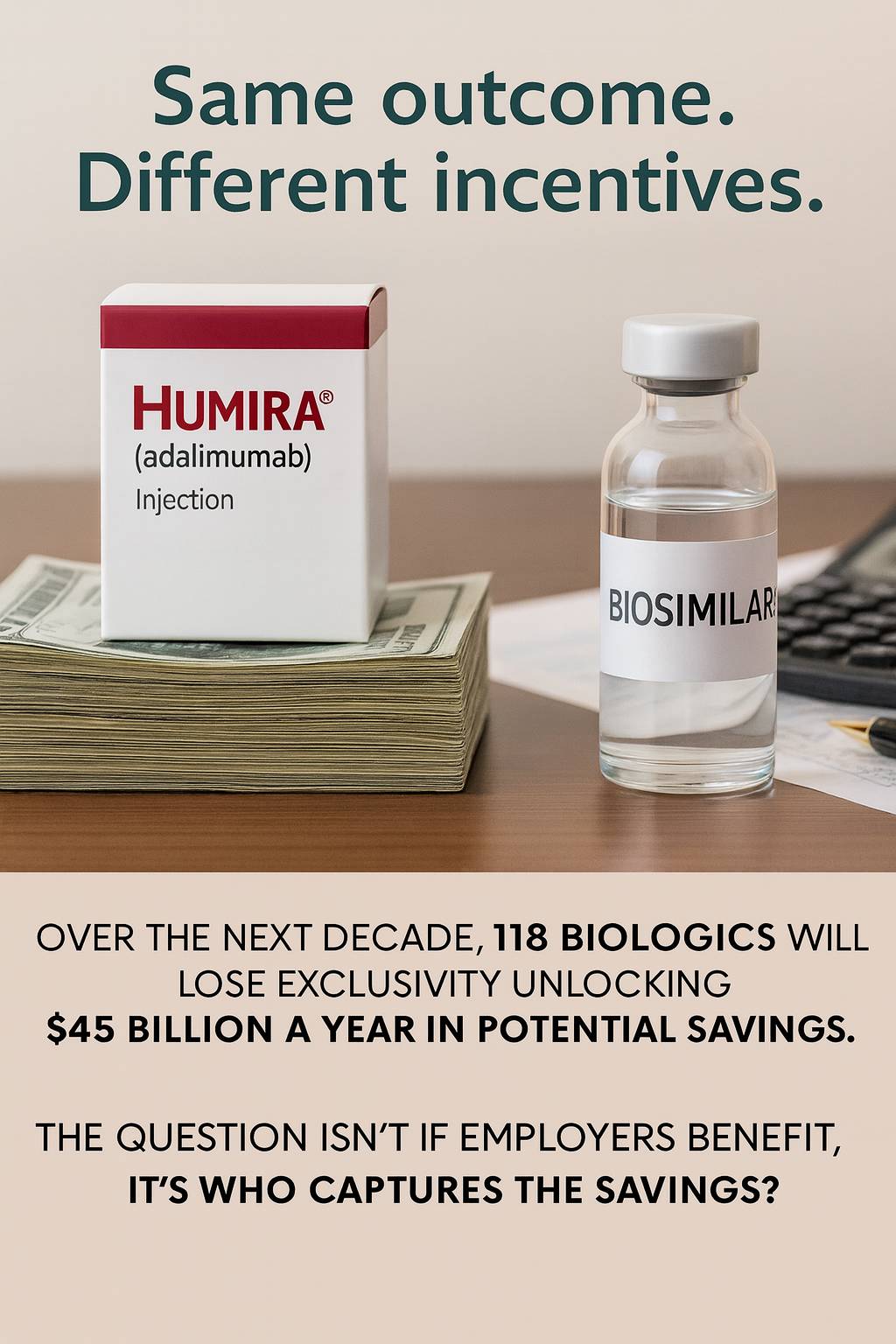
Over the next decade, 118 biologics will lose exclusivity and unlock more than $45 billion a year in potential savings, according to Evernorth’s Pharmacy in Focus report
The question isn’t if employers benefit. It’s who captures the savings.
PBMs are already maneuvering to keep the cash flow under their control:
Q1. What’s driving the buzz around biosimilars right now?
Bryce (Pharmacy Management Consultant with Milliman): “Billions of dollars are about to move from brand biologics to biosimilars. Humira shows how fast this can happen. $200 million saved in 15 months is hard to ignore.”
Nina (Founder and CEO of Healthcare Decision Making): “We’re finally seeing evidence competition works. But only when plan sponsors push for it. The science is solid; the economics are what’s in question.”
Q2. If biosimilars lower costs, why aren’t they winning faster?
Bryce: “It wasn’t until the big PBMs changed their formularies that we started to see shifts in market share for Humira biosimilars. If you’re still seeing the same high or increasing rebate guarantees from your PBM, there’s a real possibility that the higher-cost brand products are still being covered on your formulary.”
Nina: “Traditional PBMs profit from rebates tied to the branded biologics. That creates a perverse incentive to block biosimilar access.”
Q3. What can employers learn from Humira?
Bryce: “Humira biosimilars generated $200 million in savings for a 21-million-member population. Clear proof the market works when it’s allowed to.”
Nina: “Employers should treat this as a model. Ask your PBM how those savings translate to your own plan and what’s blocking faster adoption.”
Q4. What’s next on the horizon?
Bryce: “The Evernorth report lists 118 biologics losing exclusivity. Keytruda alone has $29.5 billion in sales. Delaying biosimilars by just five years could cost commercial plans over $45 billion in lost savings, according to Evernorth’s modeling.”
Nina: “This isn’t a one-drug story. It’s a pipeline transformation. Employers who act early will shape the market instead of reacting to it.”
Q5. What should employers do right now?
Bryce: “Optimize the formulary quickly and prepare to help your providers and patients navigate these transitions. You have to remove the barriers blocking timely biosimilar access.”
Nina: “Run a biosimilar audit: which drugs, what costs, and what barriers exist in your plan.”
Boardroom Perspective
Without a biosimilar strategy, your plan is subsidizing the old brand economy.
Strategy and oversight, not rebates, drive savings.
Demand transparent pricing, acquisition-cost benchmarks, and formulary reviews.
Key Takeaways
Humira proved biosimilars can slash specialty spend fast.
118 biologics are next with a $45B opportunity if employers act.
PBM rebate and ownership conflicts still block adoption.
Employers must build a biosimilar strategy and demand acquisition-based pricing.
Bottom Line:
Biosimilars are the next fiduciary frontier. Act before your PBM does.
Bryce Platt, PharmD is a healthcare strategist bridging the clinical, financial, and policy dimensions of U.S. pharmacy. Bryce is a valued contributor to the Nautilus PBM Project and developed the Curated List of PBM Studies in the Executive Thought Leadership library.
Nina Lathia
Nina Lathia, RPh MSc PhD is the Founder & CEO of Healthcare Decision Making. Author of Pharmacy Benefits Uncut newsletter Nina helps employers optimize pharmacy benefit design. From Toronto, she brings a global perspective and proof PBM challenges transcend borders.
Visit nautilushealth.org/pbmto find educational resources, procurement tools, model contract terms, the PBM Configurator, and other tools.
💸 SPECIAL OFFER: Newsletter subscribers receive 10% off any Validation Institute service. Use code FIDUCIARY10 at checkout.
validationinstitute.com
📬 PAY IT FORWARD: Feel free to forward this offer to your broker, PBM, or other vendors. Don’t hesitate to tell them you will favor validated vendors as part of your modernized procurement processes. Strong compliance and better benefits begin with validation.
Don’t be a bystander. Change the status quo and reap the benefits of The Health Plan Compliance Advantage.