What 58 contracts reveal about the one you signed.
Executive Brief
Last week we established the stakes. The CAA made the plan sponsor personally liable for fiduciary duty. “I trusted my PBM” is not a defense.
This week we open the contracts. We used Contract X-Ray to examine
fifty-eight PBM agreements from twenty-six PBMs. Every contract was scored provision by provision against the same rigorous standard. The numbers tell a story the vendor pitch decks do not.
Market Statistics
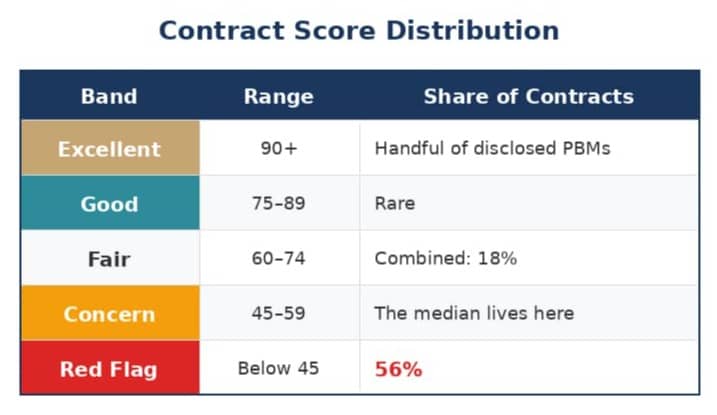
Fewer than one in five reach Fair or better. More than half score Red Flag. The Big Three PBMs average 24 out of 100.
These are not broken contracts. They are contracts built to a different standard. A standard serving the PBM, not the plan fiduciaries.
What We Measured
Contract X-Ray reads a PBM contract the way an auditor reads a ledger. Word by word, front to back. Ten provisions in three domains:
Fiduciary Conduct. Does the PBM act in the plan’s interest? Loyalty, conflicts of interest, lowest net cost.
Financial Integrity. Does the plan’s money stay the plan’s? Pass-through pricing, rebates, fee transparency.
Oversight and Control. Can the sponsor see and enforce the deal? Data ownership, audit rights, carve-out rights, termination.
Each provision earns a score on a fixed scale. Those scores roll up into a single number: the Fiduciary Alignment Score. The same ten provisions, the same scale, for every contract. Any two can be compared on the same terms.
What the Contracts Show
The median contract scores 42. That places it in Concern, the band where a contract fails more provisions than it passes.
Contract X-Ray Scoring Bands
More than half the contracts in the database can’t protect a fiduciary. They weren’t written to.
Business Model Predicts the Score
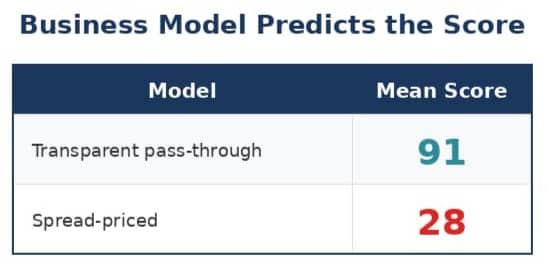
The clearest signal of what to expect is not the PBM’s name. It is how the PBM makes money.
Business Model Scoring
Ninety-one to twenty-eight. The gap is not a rounding error. It is a business model made visible.
Pass-through PBMs charge the plan exactly what the pharmacy is paid. Every manufacturer dollar reaches the plan. The only revenue is the administrative fee they name. There is nothing to hide, so the contract does not hide it.
Spread-priced PBMs keep the difference between what the plan pays and what the pharmacy receives. They retain a share of manufacturer revenue. Their economics depend on complexity. The contract protects that complexity.
The Big Three PBMs, the ones that manage most of the market, average 24 out of 100. On a scale where anything under 45 is a Red Flag.
Where Contracts Fail Most Often
Two provisions fail in nearly three of four contracts:
Fiduciary loyalty. Does the contract require the PBM to act in the plan’s interest? Seventy-two percent of contracts do not commit to this. The PBM’s duty, if any, is to itself.
Carve-out rights. Can the plan adopt a better point solution without penalty? Seventy-two percent of contracts restrict or prohibit it. You found a better deal. Your contract says you can’t take it.
These are not edge provisions. They are the structural terms that decide whose interests the contract serves.
The Clause You Were Meant to Skip
The audit rights provision. Page 47. Section 12.3.
It states that any audit must be conducted by an auditor “mutually agreed upon” by the plan and the PBM. It limits audits to once per contract year. It restricts the auditor’s access to “summary data” rather than claims-level detail. It prohibits extrapolation. It requires findings to remain confidential.
This clause was not drafted carelessly. It was drafted precisely.
Designed to survive a skim. Written so that if you do read it, you will not realize what it costs you until you try to use the right it appears to grant.
Your contract probably has a version of this clause. Most do.
The Standard Already Exists
The provisions that fail most often are not mysteries. Model language exists for each one. A growing number of PBMs have already signed it.
On all ten provisions, at least one contract in the database reaches model language. The standard is not theoretical. It is already in the market. Someone has already signed it.
The question is whether your contract matches what is already available or falls short of a bar someone else has already cleared.
What to Do First Thing Monday
Request a Contract X-Ray Quick Look report. Go to contractxray.com. It’s free, through the National Alliance partnership. Receive a PDF in your inbox in about three minutes.
Look for fiduciary loyalty. Does your PBM commit to act in the plan’s interest? If the answer is missing, that is the answer.
Check your carve-out rights. Can you move specialty to a different vendor without penalty? Can you add a transparent pharmacy option? The contract decides if you can exercise your fiduciary duties.
In Closing
For decades, the most important document in a health plan was written to be unreadable. The contract.
The words that should have meant the most like transparent, pass-through, and fiduciary aligned really meant whatever the vendor wanted them to mean.
You can’t hold anyone to a word you can’t define. And a whole industry was built on keeping those words hard to define.
Thanks to Contract X-Ray, now they have definitions. Now they have scores. Now the question is whether your contract measures up to what is already in the market or falls short of a standard someone else has already met.
Once you see it, you can change it.
Here’s to clearer thinking, stronger plans, and better outcomes for the people who rely on us.
All the best,
P.S. Next week we stop talking about the standard and start measuring against it. We scored real PBM contracts, the kind employers sign every day, against a fiduciary benchmark. Most failed.
Subscribe & Share
🔗 Subscribe: Was this newsletter forwarded to you? Signup to receive The Health Plan Compliance Advantage every Monday.
📤 Share: Know someone reviewing a PBM contract? Forward this issue.
💸 SPECIAL OFFER: Newsletter subscribers receive 10% off any Validation Institute service. Use code FIDUCIARY10 at checkout.
────────────────────────────────────────
Don’t be a bystander. Change the status quo and reap the benefits of The Health Plan Compliance Advantage. Schedule an introductory call with us.