We Scored Mark Cuban’s Contract
Full Negotiation Report and Book Foreword, Both Free
Executive Brief
Something changed in the PBM market this year, and many plan sponsors haven’t realized it yet.
Ten PBMs have rewritten their standard contracts to score 90 or better on Contract X-Ray. Not one started there. All but one began in Red Flag, the lowest tier we score. The average improvement is 39 points.
Nobody made them do it. No regulation requires a contract score, no enforcement action sits behind it, and no penalty applies to a vendor that refuses. They rewrote their contracts because they want to align their interests with plan sponsors.
It’s an open process every PBM and plan sponsor can take advantage of. And now Mark Cuban has published a model PBM contract and is revising it in the open on social media.
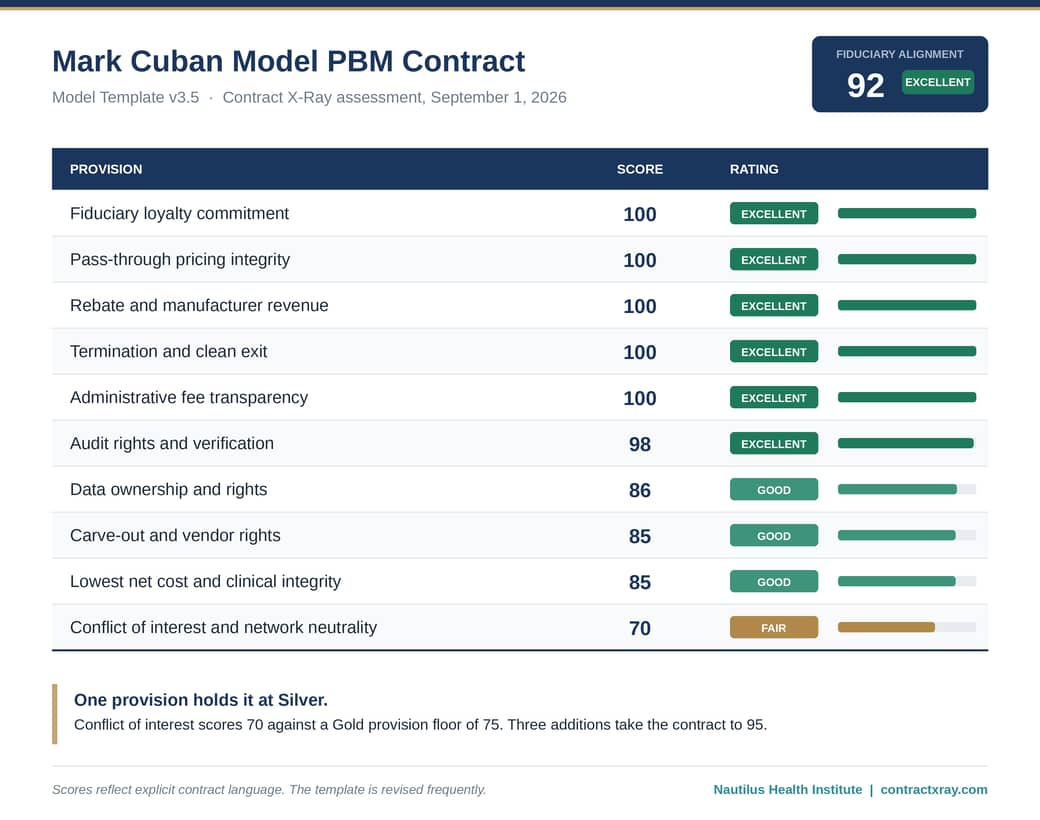
We scored version 3.5 on September 1. It came in at 92, Excellent rating on the Nautilus Fiduciary Alignment Score. Six provisions rate Excellent, three Good, one Fair. Nothing scores Concern or Red Flag.
That’s a great result. Everyone should thank Mark (along with his AI agents and crowdsource collaborators who made it better).
This newsletter issue covers what a 92 contains, the language that closes the remaining gap, and one thing to understand before you print the model contract and hand it to your incumbent PBM.
All the details are in a downloadable Contract X-Ray report. Plus, for a little signing season inspiration, the Foreword from my new book The Middleman’s Cut.
Ten PBMs Already Clear It
You don’t have to take the contract standard on faith. Ten PBMs with standard contracts scoring 90 or better as of September 1:
AffirmedRx · DisclosedRx · LucyRx · MedOne · Rescription · Serve You Rx · Slate Rx · SmithRx · US-Rx Care · Ventegra
Not one of them started there. All but one began in Red Flag.
Here’s the part worth sitting with. Their contracts weren’t bad. The market moved and they needed to move with it in anticipation of CAA 2026.
The same issues apply to your current contract. You need to move too.
The Sentence
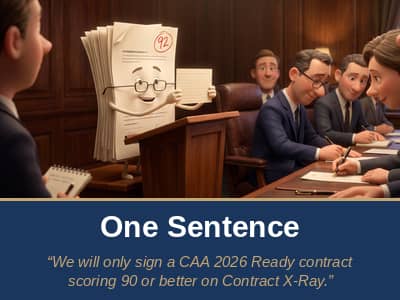
“We will only sign a CAA 2026 Ready contract scoring 90 or better on Contract X-Ray.”
One line in a request for proposal. Companies, cities, states, unions, coalitions. The same sentence works for all of them.
It works because it can be answered using Contract X-Ray.
“We want a transparent PBM” is a preference built on marketing. “Provide your CAA 2026 Ready contract scoring 90 or better on Contract X-Ray” is a bid requirement, and a vendor either meets it or explains why not. Both answers are useful, and both belong in your fiduciary file.
It also changes what’s being negotiated. Instead of arguing over your plan’s terms, you’ve set a condition of doing business. A vendor that rewrites its standard contract has rewritten it for everyone who comes after you. That collective action moves markets.
That’s what happened to the ten above.
What a 92 Actually Contains
Most plan sponsors have never read a model contract like the one Mark Cuban built, which makes the standard sound theoretical. It isn’t.
The construction producing the score is worth understanding, because it’s a solid mechanism rather than a promise. Every dollar arising in connection with the plan is assigned to one of six named categories.
Any dollar falling outside those categories is retained in breach and recoverable. Then a named officer with authority over the business must certify, quarterly and annually, that all of it has been disclosed and remitted. A knowingly false certification is a material breach and cause for immediate termination.
Most agreements leave the space between what the plan pays, what the pharmacy receives, and what the manufacturer returns wide open. This one closes it and puts a signature on the closure.
Silver Today, Gold Within Reach
The Nautilus Data Sovereignty designation requires two things independently: the overall score clears a threshold, and each of five named provisions clears a floor of 75.
This model contract clears the threshold at 92. It misses the floor on exactly one provision. Conflict of interest, at 70.
The exposure isn’t that the conflict architecture is weak. It’s the strongest in our reference set. Section 1.1 defines three tiers of related entity, reaching material equity, management rights, profit participation, purchasing control, and entities affiliated through contract rather than equity. Every related entity pharmacy claim is invoiced at net acquisition cost with no margin in any channel.
What it never does is ask the vendor to state what it owns.
So a plan sponsor can’t monitor ownership structures nobody was asked to disclose, can’t reach a principal or family member holding an interest personally, and can’t learn about a network change until after it happens.
Here’s the language that closes it, exactly as it appears in the Contract X-Ray Negotiation Report.
PBM represents and warrants that Exhibit A-5 states every ownership or financial interest held by PBM, any PBM Related Entity, its principals, or their immediate family members in any pharmacy, including mail order and specialty pharmacies, and in any pharmaceutical manufacturer, wholesaler, distributor, or group purchasing organization. PBM shall update Exhibit A-5 within thirty (30) days of any change, and the Section 2.6 certification shall extend to its completeness. PBM shall provide the Plan Sponsor ninety (90) days advance written notice of any material change to the pharmacy network, including any addition or removal of a PBM Related Entity pharmacy and any change affecting Member access.
Naming ownership in an exhibit costs an honest bidder nothing. It tells a plan sponsor exactly what it’s buying if there’s something to tell.
Two more gaps sit just above the floor. Data ownership, 86, where claims data and the drug lists are the plan’s property but member, eligibility, accumulator, and derived data aren’t named and the word sole never appears. And lowest net cost, 85, where the contract measures price against an acquisition benchmark but never requires the vendor to compare this plan’s per-member cost against its own book of business.
Those three additions take the contract to 95 and produce a Gold designation.
The Whole Report Is Yours
We’re publishing the full Contract X-Ray Exec Brief & Negotiation Report on version 3.5. No form, no gate.
Five prioritized gaps. For each one: the current contract language cited by section, the fiduciary risk, the model language to propose, and the talking points to support the conversation. Then a priority checklist sorted into non-negotiable, important, and recommended terms.
It’s the same report a plan sponsor receives on their own contract.
→ Download CXR Exec Brief & Negotiation Report – Mark Cuban Template
Before You Print It and Hand It to Your Incumbent
A model contract can look like a shortcut. Print it, put it in front of your PBM, get it signed.
That isn’t how this works with the largest vendors, and it’s worth saying plainly before anyone tries.
Where The Model Started
Mark Cuban’s work began with a real contract. He posted the CalPERS agreement, publicly available and negotiated by the second largest employer purchaser of health benefits in the nation, as an example of what good looks like. Then he used AI and crowdsource collaboration to build something better.
We scored the CalPERS contract. Eighty-four.
That’s the highest score we’ve recorded for any agreement with a “Big 3” PBM. A purchaser of that size, with a public procurement process, experienced counsel, and every incentive to push hard, negotiated to 84.
Mark Cuban’s v3.5 of his model contract scores Ninety-two.
The eight points between them are what a contract can contain but a negotiation with a major didn’t produce.
Eighty-four is a real achievement. Against a corpus median of 42, it’s near the top of everything we’ve scored. And it’s the ceiling, produced by about as much leverage as an employer purchaser can bring.
So if a purchaser of that scale lands at 84, a 5,000-life employer is not going to hand a Big 3 PBM a model contract and get it signed as is. The standard isn’t a document you hand over. It’s a measurement you apply, and it works differently depending on which road you take.
If you’re going with one of the Big 3, run Contract X-Ray on whatever you’re offered. You may not get these terms, but you’ll know precisely which fiduciary protections you gave up, what each one was worth, and that you asked. That’s the difference between a compromise you chose and one nobody noticed, and it’s the fiduciary documentation your board and your counsel will want.
If you’re going with one of the ten already scoring 90+, the negotiation is already over. No redline campaign, no six-month argument about whether pass-through is operationally feasible.
And if a vendor walks away rather than discuss its own contract language, that’s information. You learned in September what you’d otherwise learn in year two, when leaving costs more than staying.
Probably the biggest favor they could do for you.
About Mark Cuban’s Involvement
Worth saying plainly what he’s doing, because it’s unusual. And extremely valuable.
Mark Cuban talks about healthcare middlemen everywhere he can find a microphone: to employers, on podcasts, in front of congress. Always blunt, always on message.
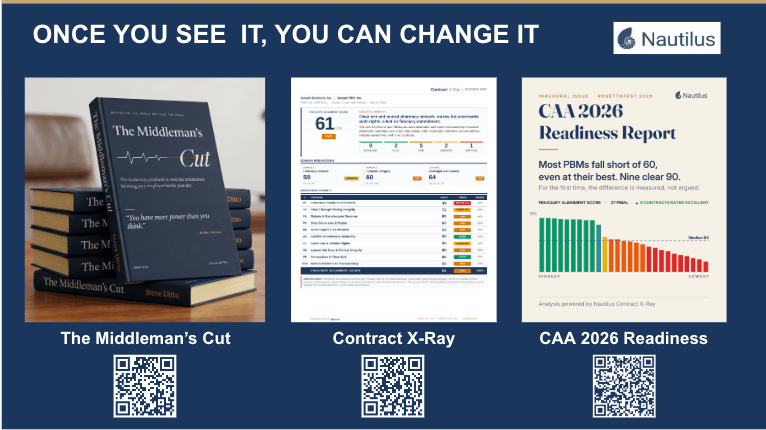
He inspired me to write The Middleman’s Cut. The book draws on his public comments, used with his permission. The Foreword is particularly compelling building the case for change. And for the first time I’m including a free version for readers of this newsletter to download.
→ Download the Foreword
Now he’s built a reference document plan sponsors can use, revising it in public, and giving it away. Every prior attempt at a PBM contract standard was negotiated privately and revised in secret.
At Nautilus, our role is independent scoring. To be clear, we scored his model contract the way we score everyone’s: against an open rubric anyone can apply and we publish the gaps alongside the strengths. He gets no different treatment than a PBM submitting a template, and neither does anyone else.
What to Do This Week
- Put this sentence in your next RFP. “We will only sign a CAA 2026 Ready contract scoring 90 or better on Contract X-Ray.”
- Read the Negotiation Report. Five gaps, the model language for each, and the talking points. Free, ungated, and it’s the same report we’d produce on your contract.
- Use Contact X-Ray. The Quick Look report is free. The full assessment pricing is scaled by plan size
- Download the foreword. Cuban’s words on why this problem exists and who pays for it. Free, and yours to forward to anyone who needs to understand the stakes before signing season closes.
In Closing
For years the honest answer to a plan sponsor asking what good looks like was that nobody could say precisely. Everyone agreed the contracts were bad. Nobody could point at a better one.
That’s over. There’s a scoring rubric and it’s public. There’s a model contract and it’s free. There are ten PBMs whose standard agreements clear the bar.
You may not get everything on this list. CalPERS didn’t. But knowing what you gave up, and being able to show you asked, is a different position than the one most plan sponsors are in right now.
Signing season is open.
The contract you sign this fall governs through 2028 and likely beyond.
One sentence in your RFP is where it starts. CAA 2026 readiness needs to be at the heart of your renewal plan.
Tell your advisor and PBM, “We will only sign a CAA 2026 Ready contract scoring 90+ on Contract X-Ray.”
You have more power than you think.
Once you see it, you can change it.
Here’s to clearer thinking, stronger plans, and better outcomes for the people who rely on us.
All the best,
P.S. Hope you find value in the two downloads. Now it’s back to the regular Monday schedule.
Subscribe & Share
🔗 Subscribe: Was this newsletter forwarded to you? Signup to receive The Middleman’s Cut every Monday.
📤 Share: Know someone reviewing a PBM contract? Forward this issue.
Tools and Resources
────────────────────────────────────────
Employers pay far more than they should to middlemen most executives have never heard of. Change the status quo and reap the benefits. Employers who act are recovering 20% to 30% of pharmacy spend, and returning it to wages and benefits.
Schedule an introductory call with us.