Last week at RosettaFest, Cristy Gupton told me our motto should be “stop signing stupid contracts.” The line gave me a real chuckle. She’s been a Health Rosetta advisor for a long time and has seen her fair share of stupid PBM contracts come across her desk.
She’s right. But the expensive risk is quieter than that. Across the 67 contracts in our reference database, 78% fall below 60. Score enough of them and a pattern shows up. The most expensive provisions in a PBM contract are the ones absent from the page.
Nobody should sign a stupid contract. But people do sign silent ones all the time, drafted by someone who knew exactly what each quiet part was worth.
Silence Scores One Point Above Adversarial
I went back to the data. Of those same 67 contracts, 55% land in Red Flag. Silence drives many of the low scores.
Each provision is scored 0 to 5. A 0 means the contract contains language working against the plan. Silence lands at 1. A 5 matches model language a fiduciary would want.
Most people assume silence should score in the middle. Neutral language, neutral outcome, something to sort out later in good faith. They’d be wrong.
A contract is a list of what the parties agreed to. Almost everything falling outside the list is an opportunity for a PBM to make more money at the plan’s expense.
Here’s the test worth running on yourself. Two contracts land on your desk. One says the PBM retains all manufacturer administrative fees. The other says nothing about manufacturer fees. Most people prefer the second one. It’s shorter to read and easier to understand.
The second one is more dangerous. The explicit version told you exactly what to negotiate and handed you the language to strike. The silent version produces the same economics but gives your review team a document with nothing to catch.
Every Silence Is a Revenue Opportunity
The gaps cluster in the same places across the database.
Manufacturer administrative fees go unnamed. Data licensing and resale go unnamed. Group purchasing arrangements, often domiciled offshore, go unnamed. Specialty steering to an affiliated pharmacy goes unnamed. Post-adjudication adjustments go unnamed. Each of those is a revenue stream, and each defaults away from your plan the moment the contract stays quiet.
No vendor forgets a revenue stream. They just decline to mention them.
The cleanest example in the corpus is a contract using the word “Rebates” throughout its pricing exhibit and never defining it. The term does real work. It sets what flows back to the plan. Leaving it open hands the definition to the party writing the check.
That’s why Cristy’s line lands so hard. The document may be stupid but it isn’t careless. From the vendor’s side, everything requiring precision gets precision. From the buyer’s side, the terms requiring precision are the ones left silent.
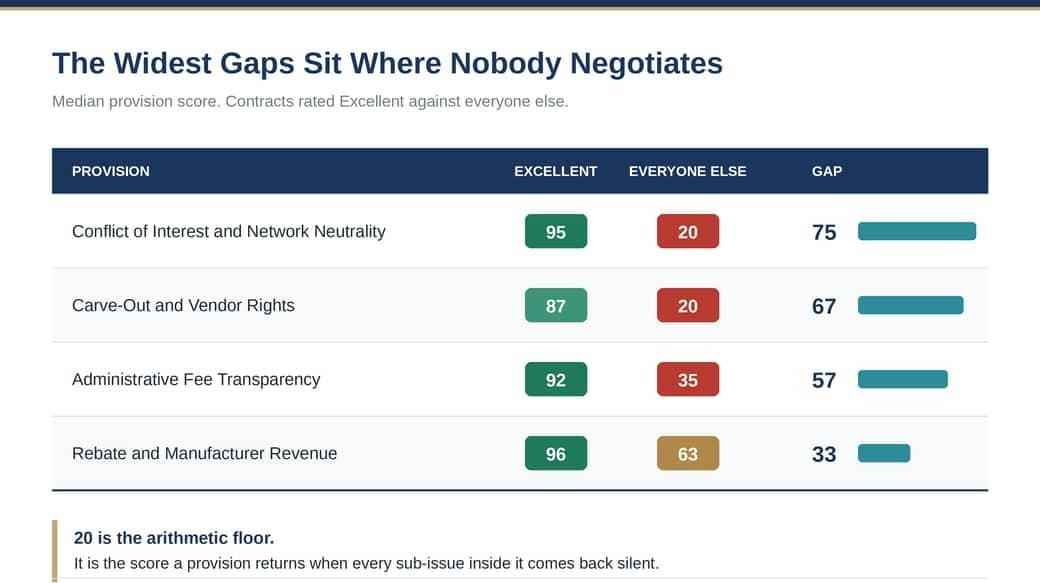
The Widest Gaps Sit Where Nobody Negotiates
On the median contract outside the Excellent band, conflict of interest and network neutrality scores 20. Carve-out and vendor rights scores 20.
Twenty is the arithmetic floor of silence. It’s the number a provision returns when every sub-issue inside it comes back silent. A score of 20 means the document says nothing on that provision at all.
Sixty-three provision scores across the database land on exactly 20. Half the contracts carry at least one.
Compare the contracts scoring Excellent against everyone else and the spread shows which terms actually get discussed at the table.
Which Terms Get Negotiated
Conflict of interest and carve-out rights rarely come up at all, and the spread runs 75 and 67. The provisions nobody raises cost you money and reduce your ability to meet fiduciary obligations.
Rebates get negotiated. Every RFP asks about them, both sides arrive prepared, and the spread closes to roughly 33 points.
The ceiling tells the same story from the other end. Of the 37 employer-specific contracts scored so far, the highest reaches 61.
Not one contract an employer actually signed has cleared Good.
One Kind of Silence Works in Your Favor
The rule is narrower than the slogan, and the exception is worth knowing before you go looking.
Silence scores at the floor where the default benefit accrues to the PBM, which covers most of the ten provisions: rebate definitions, fee disclosure, audit access, conflict commitments. Absent a term, the PBM decides.
Some silence runs the other way. You hold authority over your own benefit plan by default. Where a contract once restricted that authority and the restriction came out, silence restores what was already yours. That scores a 4.
One PBM in the Readiness Report cohort proved the point this spring. Its prior template carried blanket exclusivity and five interlocking penalty mechanisms across two exhibits. The revision deleted all six and added no replacement language. Carve-out rights scored 80.
Some provisions ask whether a harmful term is absent. Termination fee is a good example. A contract with no termination fee has answered the question. Marking it down for lacking a paragraph disclaiming a fee it never charges would invert the test.
So the working rule is this. An unwritten term defaults to whoever holds the control, and on most provisions that party is the PBM.
Explicit Terms Are the Only Collectible Ones
Read enough scorecards and the Fiduciary Alignment Score turns out to measure something simple: how much of your deal exists in writing. It demonstrates fiduciary discipline and prudence in contracting.
Explicit language does four things silence can never do. You can price it, because you know what you’re buying. You can audit it, because there’s a stated figure to test. You can enforce it, because breach requires a term to breach. And you can terminate it, because an exit requires a cause the contract recognizes.
One example in the database shows what closing a gap is worth.
A PBM’s early termination fee included recapture of all rebates earned. That fee equaled a potential payment measured in millions. A handcuff so large it effectively meant there was no ability to terminate. The contract was silent on the business reason and the anticipated costs.
What changed after remediation is the contract now states what the fee is for. It says the fee represents unrecovered up-front implementation investment, amortized straight-line monthly over the contract term. It says the fee excludes lost profits. The calculation is documented.
That’s a legitimate business expense. The language earned ten points on the fee question itself. The other nineteen came from somewhere more interesting. A termination fee no one can evaluate fails the reasonableness test, and a failed test caps the entire provision no matter how strong the other terms are.
Once the fee carried a stated basis, the cap came off, and the improvements the PBM had already made to rebate continuation and data return could finally register.
What This Newsletter Is Now
By now you’ve probably noticed the new name. The Middleman’s Cut.
The original compliance frame got too small. What we’ve been writing about is the money moving between an employer and the benefits it pays for, and who takes a cut on the way through. So the newsletter now shares the book’s name.
For the past year, when people ask what I do, my tongue-in-cheek response has been “I make drugs cheaper.” That’s still a focus, and over the coming year it’s going to expand a bit. There are middlemen all over healthcare. Between you and your pharmacy. Your doctor. Your hospital.
Many of the practices we’ve discussed, “PBM shenanigans” as Dave Chase likes to call them, exist everywhere. There’s a lot of cross pollination going on between pharmacy and medical benefits.
Pharmacy is a great place to start. It’s getting more visible and it’s highly addressable. But the money is bigger elsewhere, and we have to go there too.
Over the next several weeks we’re taking the drafting apart one technique at a time. Omission, which is today. Redefinition, where money moves by changing what a word means. Restriction, where a right exists on paper and stays unusable in practice. Lock-in, where leaving costs more than staying wrong.
Each technique protects the one before it. Silence stays profitable while auditing stays hard. Audit limits hold while exit stays expensive.
The timing is deliberate. August through October is when employers decide whether to renew or go to market for a January 1 effective date.
Whatever you sign this fall governs through 2028, which covers the whole CAA implementation window.
What to Do First Thing Monday
Turn to conflict of interest and carve-out rights in your contract. These are the two provisions where the median contract scores at the floor. If your document says nothing about network neutrality or your right to carve out a therapeutic class, you already know your score on both.
Check that every term doing pricing work appears in the definitions section. Start with Rebate. If the pricing exhibit uses a word the contract never defines, the party writing the check defines it.
Ask your PBM to name every source of revenue it earns in connection with your plan, in writing. Manufacturer payments, data licensing, affiliated pharmacy margin, group purchasing arrangements. Frame it as a CAA disclosure question, because it is one.
Find your renewal date and your notice deadline. Auto-renewal with a 90-day notice requirement means your decision is due well before your review is finished.
Tools and Resources
Tools and Resources
A Note of Appreciation
Cristy Gupton
Cristy Gupton, award winning benefits professional and Charter Certified Health Rosetta Advisor. Founded in 2006, Custom Benefits Solutions (CBS) is an employee benefits consulting firm that works as a trusted advisor with employers across the country. CBS helps employers design and administer employee benefits programs that help achieve their overall organizational strategic goals.
In Closing
Cristy was frustrated on behalf of her clients. And that frustration is justified. “Stop signing stupid contracts” cuts through a lot of BS.
Every dollar leaking through an unwritten term is a dollar your plan spent without buying anything for the families it covers. Somewhere in your plan there’s a parent paying a price shaped by a category the contract left blank.
That blank was a decision. Somebody chose it, on a specific afternoon, for a specific reason. Which means somebody can fill it in. One PBM turned a fee that made leaving impossible into a number a plan sponsor can check, and gave up nothing real to do it. Your contract has blanks worth more than that.
Once you see it, you can change it.
Here’s to clearer thinking, stronger plans, and better outcomes for the people who rely on us.
All the best,
P.S. Next week: the definitions section, where one word changes what you pay across thousands of claims. And a number I keep returning to for the issue after that. Across 67 scored contracts, the median score for termination and clean exit is 49. Leaving is the right you’re least likely to hold.
Subscribe & Share
🔗 Subscribe: Was this newsletter forwarded to you? Signup to receive The Middleman’s Cut every Monday.
📤 Share: Know someone reviewing a PBM contract? Forward this issue.
💸 SPECIAL OFFER: Newsletter subscribers receive 10% off any Validation Institute service. Use code FIDUCIARY10 at checkout.
────────────────────────────────────────
Don’t be a bystander. Change the status quo and reap the benefits of The Middleman’s Cut. Schedule an introductory call with us.