Eighteen months ago this newsletter started as The Health Plan Compliance Advantage, and compliance was the right frame for the moment. The job was defensive and it was your responsibility alone to know your obligations, document your process, protect your plan.
The frame got too small. What we’ve been writing about for a year is the money moving between an employer and the middlemen standing between you and your benefits.
Middlemen exist everywhere in healthcare. Between you and your doctor. Your hospital. Your pharmacy. They extract money off the bottom line of employers and out of the pockets of employees and their families.
That’s why this newsletter and the book exist.
Once you see it, you can change it.
Starting with this issue, the new name is The Middleman’s Cut. Same author, same Monday delivery, same focus. Fiduciary intelligence on the money between you and your benefits, written for the people who sign the deals.
WELCOME TO ISSUE #87
The Argument Is Over
Pass-through. Transparency. Fiduciary alignment. Three words the market argued about for a decade. Last week they became three numbers.
For years the most consequential words in a PBM contract were words with no fixed meaning.
Pass-through. Transparent. Fiduciary aligned. Every PBM claimed all three, and no purchaser could test any of them. You can’t hold a vendor to a word you can’t define, and a whole market was built on keeping those words loose.
Thursday in Nashville, Nautilus released the CAA 2026 Readiness Report. Twenty-seven PBM contracts, scored against model language written by a panel of benefits attorneys, pharmacy contracting specialists, and fiduciary experts, with a clause-level citation behind every judgment.
The debate over what those words mean is finished. What the market did next is the part worth your attention.
Three Words, Three Numbers
Contract X-Ray reads a PBM contract against ten provisions in three domains: whether the PBM acts in the plan’s interest, whether the plan’s money stays the plan’s, and whether the sponsor can see and enforce the deal.
Each provision scores from 0 to 100. Zero means the language works against the plan. Silence scores a 1 out of 5, because silence on a revenue channel is never neutral. It means the PBM keeps it.
Stack the provisions different ways and the marketing terms resolve into measurements.
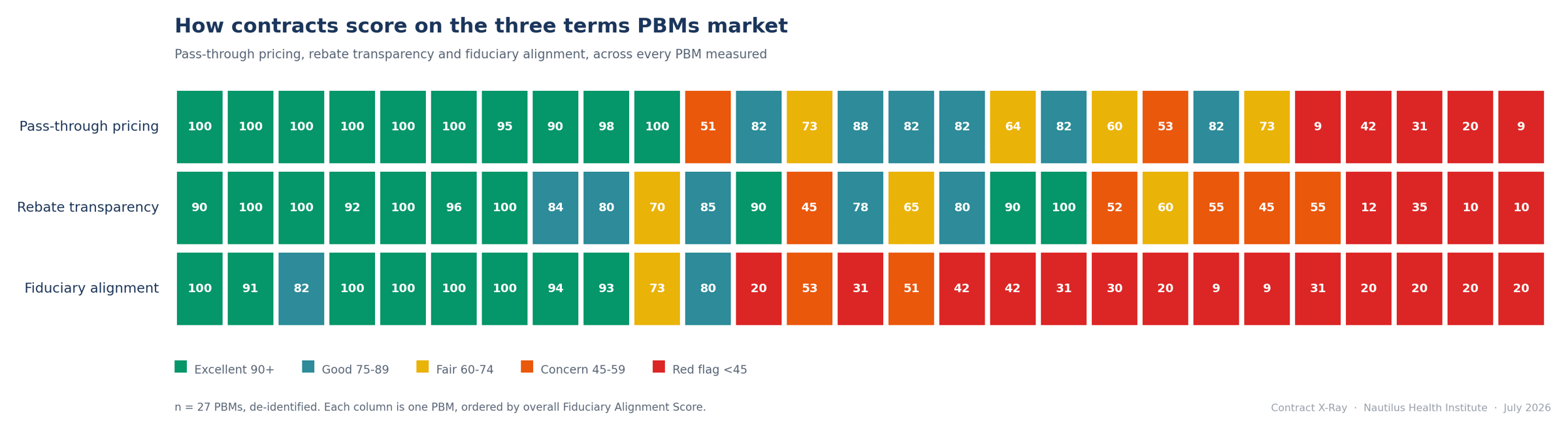
Pass-through is two provisions: pricing and rebates. The plan pays the pharmacy’s actual cost with no retained spread and no post-adjudication clawback, and every manufacturer dollar reaches the plan. Pass-through is necessary for transparency and for alignment, and sufficient for neither. Transparency is five provisions, and it has two halves the market routinely collapses into one. Disclosure means the vendor shows you every dollar paid and every dollar retained. Verification means you can check those figures yourself, on data you own, through an audit you control. A number you can’t audit, on data you don’t own, is a claim, not transparency. Both halves must clear 75.
Fiduciary alignment is all ten, evenly weighted, averaged into one score.
Pass-Through, Transparency, Fiduciary Alignment
Three Words Quantified Across 27 PBMs
Nobody Started at the Top
The nine contracts scoring Excellent look, on the page, like they were always good. They weren’t.
Two of those PBMs began in Red Flag. Four began in Concern. One began in Fair. Not one began at Good. One climbed from 26. For some it took five rounds of review, each round tightening the contract against the same rubric applied to every other contract in the report.
They rewrote their contracts because purchasers put scores on the table and wrote model language into procurements. That’s the mechanism, and it already works.
Then the Market Moved
The report went public and advisors and employers started calling PBMs who weren’t on the list. The question was simple. “Why aren’t you on this list?”
Those PBMs are now calling us. One has already been scored and became the tenth contract to clear 90. We expect ten or more to join the cohort by the end of the year.
Then this. One PBM told us they’re already using their model contract with their largest client to bring them to CAA 2026 readiness. We weren’t in the room. Nobody asked our permission. The standard is public, and it’s moving on its own.
That’s what a market standard does. It travels. And it takes root.
Why One Number Changes What’s Possible
A single employer negotiating alone faces the best-resourced legal teams in the country. That math has never favored the individual plan sponsor, and it never will.
What changes the math is many employers asking for the same thing in the same words. And that requires a definition precise enough to put in a document. “Find a transparent PBM” is a hope. “Provide your CAA 2026 Ready contract” is a requirement.
One employer with a score is an audit. Two hundred employers asking for the same ten provisions, measured the same way, is a market condition.
Shawn Gremminger, President of the National Alliance of Healthcare Purchaser Coalitions, wrote the report’s foreword and made the ask plainly: find out where your own contract stands, and treat “transparent,” “pass-through,” and “fiduciary aligned” as commitments to be verified rather than claims to be assumed.
The tool to answer the question exists now. That removes the last honest reason to leave it unasked.
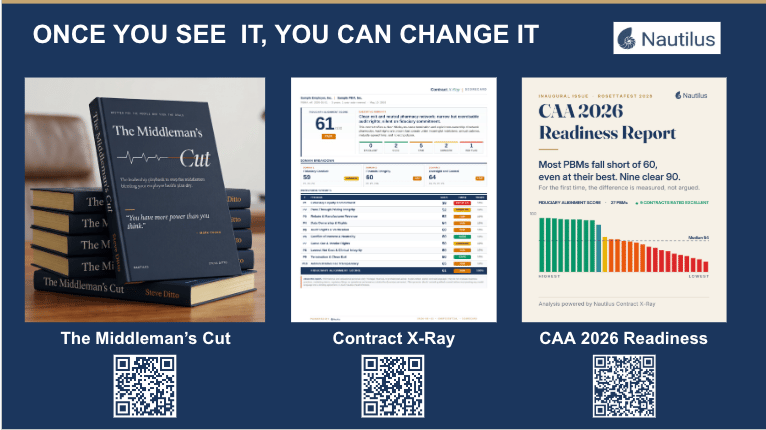
Three Tools For Enabling Change
What to Do First Thing Monday
Order the book for your leadership team. They control the budget and the risk. The book will deepen their understanding of the problem and catalyze action.
Run a free Quick Look on your current PBM contract. Upload it through contractxray.com so it joins the scored population, which makes every comparison in the next report sharper.
Email your incumbent PBM one question in writing: Are you on the CAA 2026 Ready list, and if not, what would it take? Put a date on the reply. Their answer belongs in your fiduciary file either way.
Write “CAA 2026 Ready” into your next RFP as a condition to bid. Make an Excellent rating a condition of winning your business.
In Closing
Somewhere in your plan there’s a family paying a high price for drugs built to fund a rebate they’ll never see. Every point of contract score between where you are and where the best contracts sit is money that could be reaching them instead.
You can see it now. Once you see it, you can change it.
Here’s to clearer thinking, stronger plans, and better outcomes for the people who rely on us.
All the best,
P.S. The cohort of PBM contracts scoring Excellent was nine on Thursday. It’s ten today. If you want your PBM considered for the next report, incumbent or prospect, send them to contractxray.com. The scoring is the same for everyone, and it costs a PBM nothing but the willingness to be measured.
Subscribe & Share
🔗 Subscribe: Was this newsletter forwarded to you? Signup to receive The Middleman’s Cut every Monday.
📤 Share: Know someone reviewing a PBM contract? Forward this issue.
💸 SPECIAL OFFER: Newsletter subscribers receive 10% off any Validation Institute service. Use code FIDUCIARY10 at checkout.
────────────────────────────────────────
Don’t be a bystander. Change the status quo and reap the benefits of The Middleman’s Cut. Schedule an introductory call with us.