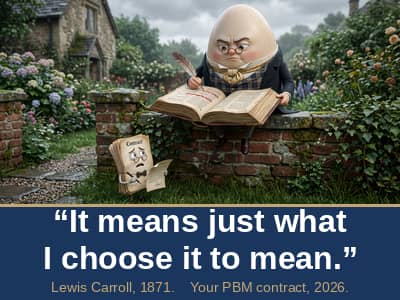
“The question is,” said Alice, “whether you can make wordsmean so many different things.”
“The question is,” said Humpty Dumpty,“which is to be master — that’s all.”
Through the Looking-Glass, 1871
Lewis Carroll wasn’t predicting anything. He was describing a permanent feature of language: meaning is shared, and any party with enough leverage can try to claim it.
Courts have quoted that exchange for over a century, almost always as a rebuke. What’s changed since 1871 is the venue. The argument moved from a conversation in a fantasy book to Article 1 of a PBM services agreement, and the stakes moved with it.
No PBM lawyer read Through the Looking-Glass and got ideas. Any party holding the pen, with no duty to the party across the table, arrives at the same technique on its own. That’s why a Victorian mathematician could describe it more than a century before PBMs existed.
Last week’s issue covered omission. This week covers the opposite move. The term is there. It’s carefully drafted. And it means something other than what you assumed when you signed.
One Contract, Read Twice
Start with a rebate provision we scored this year:
The promise. The plan gets rebates.
The definition. Rebates means formulary rebates the vendor collects. It then says rebates exclude manufacturer administrative fees. Nine more categories of manufacturer money are excluded elsewhere in the document.
The result. Manufacturers pay a PBM in many forms. Formulary rebates are one. Administrative fees, data fees, and service fees are others, and those categories are growing faster than rebates.
Interest is another item worth examining. An example:
A 5,000-life employer generating $3 million in annual rebates, paid nine months in arrears, is financing roughly $2.25 million of someone else’s working capital. At 4% short-term rates, that’s about $90,000 a year in interest.
Where contracts address interest at all, they address it to say the money belongs to the PBM not the plan.
Two more definitions in the same contract do similar work. MAC is a unit price the vendor sets and can change whenever it likes. The formulary changes at the vendor’s sole discretion with no notice.
Between the three of them, the definitions decide what a drug costs, which drugs are covered, and how much manufacturer money comes back.
Follow the Money, Then Read the Promise
A PBM evaluated with Contract X-Ray revised its standard contract between two review cycles. The rebate provision went from 70 to 95. The clause containing the promise was never touched.
Where the money goes. A manufacturer pays. The payment travels through an affiliate rebate aggregator. The aggregator keeps a cut and forwards the rest to the PBM. The PBM sends money to the plan.
The old promise. The plan gets 100% of rebates received by the PBM.
What that missed. The cut the aggregator kept never reached the PBM, so it was never money the PBM received, so the 100% promise never touched it. The promise attached to the wrong link in the chain. Everything upstream of the PBM stayed upstream.
The fix. They amended one definition. Manufacturer value now means value received by the PBM or any affiliate, paid by a manufacturer or an intermediary. They added a line confirming that a payment doesn’t get excluded just because an affiliate received it.
Exhibit B still reads exactly as it did before. It reaches further now because the words inside it mean more.
Twenty-five points, and not one word of the obligation changed.
It landed at 95 rather than 100 because the amended definition still ties value to payments connected with processing or managing claims. A pure data fee sits in ambiguous territory. Even a good revision can leave residue, and residue is what the score measures.
A Definition Is Not a Promise
The third example shows the importance of making sure definitions are operationalized.
A contract in our database defines pass-through pricing to the strictest standard we’ve seen. The plan pays what the pharmacy was paid. No spread, no exceptions. As a piece of drafting it’s excellent.
Pass-through pricing scored 31 out of 100. Red Flag.
Here’s why. No clause in the agreement requires the PBM to provide pass-through pricing. The definition explains what the term would mean if the contract used it. The contract never uses it.
A definitions section is a dictionary, not a set of obligations. Defining a word tells you what it means when it appears. If it never appears in a clause that commits the PBM to anything, the definition governs nothing.
So a plan sponsor reads Article 1, sees language stronger than anything a competitor offered, and feels good about the deal. That feeling is the entire benefit received.
One technique narrows a word the contract depends on. The other perfects a word the contract never invokes. Both produce an agreement that reads better than it performs.
Where the Score Comes From
Some people assume Contract X-Ray has a definitions score. It doesn’t, and the reason matters.
A definition is not necessarily good or bad on its own. It becomes one or the other when you see which obligation it modifies. The same words that protect a plan in one contract can gut it in another.
So we score the overall obligation, not simply the dictionary. A MAC definition affects what you pay, so it lands in pricing. A formulary control definition affects what’s covered, so it lands in clinical management. A data definition affects what you own, so it lands in data rights.
Every provision comes down to one question. After you read this language, what can the PBM still do that hurts the plan and undermines fiduciary obligations?
Which leads to the practical point. Reading the pricing exhibit and the guarantees isn’t diligence. Those pages are written in terms defined somewhere else, by someone else, for a reason. A sponsor who reviews the commitments and skips Article 1 has reviewed a document that doesn’t exist.
What to Do First Thing Monday
Read your definitions section against your pricing exhibit, side by side. Start with Rebate, MAC, Generic, and Specialty. For each one, ask what the definition excludes and who gets the excluded money.
For every defined term, find where the contract actually uses it. A term defined beautifully and never invoked protects nobody. If Pass-Through appears in Article 1 and nowhere in the obligations, you have a definition rather than a commitment.
Look for who holds the pen after signing. Any definition set by a list, index, or determination one party controls is a term that can change without an amendment. Ask what notice you get and whether you can decline.
Ask one question in writing: does the rebate definition include all manufacturer renumeration, and does it reach payments received by affiliates and intermediaries? Those two clauses moved a provision 25 points in a contract we scored. Their answer belongs in your fiduciary file.
Tools and Resources
The Book
The Report
The Tool
In Closing
The vendor in the first example never misled anyone. Every exclusion was written down, in order, available to any reader willing to work through Article 1. The definition was the disclosure.
That’s what makes this the harder technique to catch. Silence leaves a gap you can search for. Redefinition leaves a document that reads like a commitment and performs like an exception, and the fiduciary who reviewed it did the work as they understood it.
So the question Alice asked is the one to bring to your renewal. Not what the contract says. Who decides what it says, after you’ve signed.
Once you see it, you can change it.
Here’s to clearer thinking, stronger plans, and better outcomes for the people who rely on us.
All the best,
PS. Lewis Carroll used em dashes in his original text. Some might think their use indicates a product of AI. Not always. As Alice might say, its “Curiouser and curiouser!”
PSS. Next week: audit rights. One audit a year, their auditor, their site, no extrapolation. A right you can’t exercise on terms you don’t control, and what that does to everything you negotiated before it.
Subscribe & Share
🔗 Subscribe: Was this newsletter forwarded to you? Signup to receive The Middleman’s Cut every Monday.
📤 Share: Know someone reviewing a PBM contract? Forward this issue.
────────────────────────────────────────
Don’t be a bystander. Change the status quo and reap the benefits of The Middleman’s Cut. Schedule an introductory call with us.