6 Weeks To Set The Next 3 Years
The 90 Standard. Any size. Any sector.
Executive Brief
Most January 1 pharmacy contracts get signed in the next six weeks. The term will likely run three years. That’s forty-two days of attention governing more than a thousand days of spend.
For a 5,000-life employer at roughly $1,200 per member per year, the commitment can easily clear $20 million. The most valuable thing you can do with it takes one sentence and costs nothing. We call it “The 90 Standard.”
“We will only sign a CAA 2026 Ready contract scoring 90 or better on Contract X-Ray.”
CalPERS scores 84. The largest public purchaser of health benefits in the country, with a professional procurement staff and more leverage than almost anyone reading this, lands in the 80s. We’ve scored more than ten contracts in the 90s, and smaller organizations hold most of them.
Last week we scored Mark Cuban’s model contract at 92 and named ten PBMs whose executed contracts already clear 90. Every one of them started lower. Across that group, contracts gained an average of 39 points between first draft and signature. The terms moved because someone asked.
Your Leverage Expires Earlier Than You Think
Ask a benefits committee when the negotiation ends and most will say signature. The real answer comes weeks earlier.
Leverage lives in the alternative. The day you name a finalist, your alternative walks out of the room, and everything after that is drafting. You can still send redlines. You’ll get fewer of them back. The vendor knows what you know: you’ve already told your leadership you picked them.
So the calendar matters more than the language. A January 1 effective date needs sixty or more days for implementation, which puts signature at the end of October and final selection by October 19. Six weeks from today.
To make it happen, you need to position your negotiation from the beginning. Because by the time you reach the redlines, it’s a request instead of a requirement.
“We will only sign a CAA 2026 Ready contract scoring 90 or better on Contract X-Ray.”
One Sentence. Three Answers. No Bad Outcome.
The reason most plan sponsors skip this step is simpler than fiduciary theory. They think asking costs them something. Walk the branches and see what it actually costs.
They agree. You just improved a three-year contract for the price of one line in a document. Ten PBMs have already signed terms at this level, so the ask is answerable.
They decline. You learned something material while you still had a competitor in the running. A vendor who tells you in September what they won’t do has given you a gift. The same information in January arrives as a discovery request.
They tell you nobody asks for this. Now you know that ten PBMs do, that the average contract in that group gained 39 points, and that “standard” describes a habit rather than a limit.
There’s no fourth branch where asking makes your position worse. That’s the whole argument.
One clarification worth making before someone else makes it. Ninety measures contract terms, not unit pricing. Somebody will point out a 90-scoring contract can still carry weak economics, and they’re right. Terms are what let you find out. A great rate you can’t audit is a claim, not a fact, and thirty of the contracts in our corpus give the plan sponsor no unrestricted right to check.
What 90 Actually Buys
So what does the number buy you in March, when the contract is live and something looks wrong? Three provisions carry most of the difference.
Audit. The low scorers let you audit with the PBM’s written approval, using an auditor they accept, against a sample they select. The contracts clearing 90 let you audit when you decide to, with the firm you hire, against the full claims file.
Exit. The low scorers charge you to leave, hold your runout on their terms, and return your data in a format built for nobody. The contracts clearing 90 let you go on notice, with your claims history, in a file your next vendor can read.
Definitions. The low scorers let the PBM define generic, specialty, and rebate, and revise those definitions mid-term. The contracts clearing 90 fix the definitions at signature and require your consent to change them.
Same vendor. Same rates. Different three years.
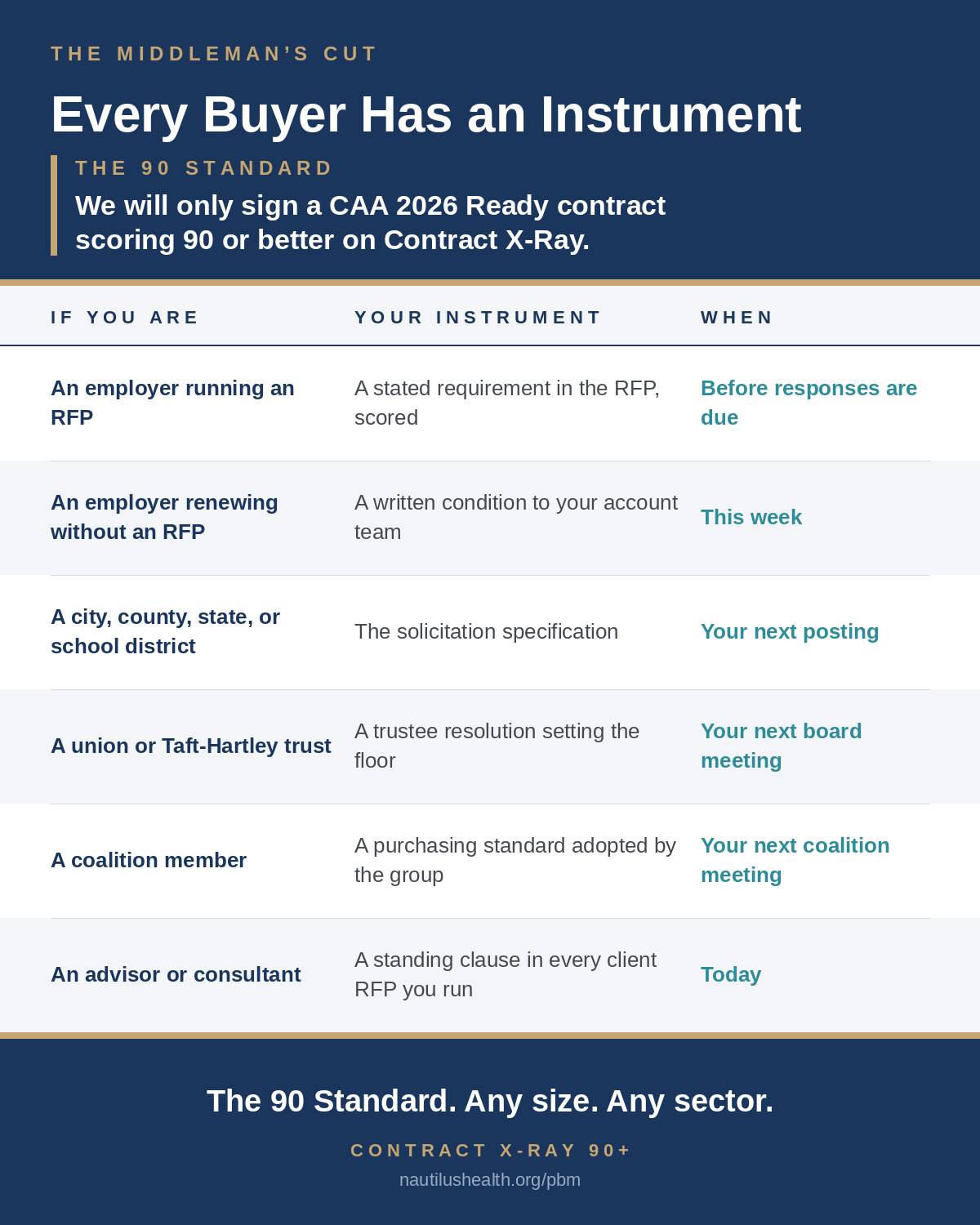
Every Buyer Has an Instrument
CalPERS scores 84 with every structural advantage. That number ends the conversation about size.
What separates the contracts in the 90s from the ones in the 80s is whether the buyer put a standard in writing before responses came in. We’ve scored the same PBM’s agreements with different employers and found different provisions in each. If leverage ran on covered lives, that variance wouldn’t exist.
You’re already big enough to apply The 90 Standard. The only open question is which document you put it in.
The trustee resolution deserves a second look. A board that adopts the floor by vote binds every renewal after it, and it survives staff turnover. One resolution outlasts twenty good intentions.
Advisors have the widest reach on that list. A consultant who puts The 90 Standard in every client RFP moves more contracts in a quarter than any single employer moves in three years.
Asking Is the Documentation
CAA 2026 asks plan sponsors to show they evaluated service provider compensation for reasonableness. Disclosure alone satisfies half of it. The evaluation, and the record of it, is the other half that’s often missing.
Here’s what makes “The 90 Standard” useful past negotiation. When you state the standard, request the score, and write down the response, you’ve created the artifact.
A committee minute reading “we required a Contract X-Ray score of 90 or better and CAA 2026 readiness; the vendor scored 74 and declined to amend Section 9; we selected an alternative” is a documented prudent process.
So is the version where you accept a 74 for reasons you record. Fiduciary duty governs process, not outcome. The exposure sits with committees who never asked, because silence documents nothing.
What to Do First Thing Monday
- Put a date on your leverage. Open your procurement calendar and mark the day you’ll name a finalist. Write “leverage ends” on it. Every term you want has to be on the table before that date.
- Insert The 90 Standard. If you have an open RFP, add it as a stated requirement. If you’re renewing, email your account team today: “We will only sign a CAA 2026 Ready contract scoring 90 or better on Contract X-Ray. Please confirm your standard agreement meets that standard.”
- Request the score. Ask each finalist to submit their standard agreement for independent scoring. A vendor already at 90 will say yes quickly. Submit your contracts at contractxray.com and you’ll receive a confidential analysis.
- Record the answer. Put the ask and the response in your committee minutes this month. Two sentences. That record is worth more in three years than anything else you’ll write this quarter.
In Closing
The people who feel this contract are the ones who’ll stand at a pharmacy counter in February and find out what their plan actually covers. They have no seat at the table where the terms get set. Their employer does.
You choose who you do business with. You choose the terms. Nothing under 90.
Here’s to clearer thinking, stronger plans, and better outcomes for the people who rely on us.
All the best,
P.S. If you’re an advisor reading this, your work product is discoverable. Next week’s issue is written for you.
Subscribe & Share
🔗 Subscribe: Was this newsletter forwarded to you? Signup to receive The Middleman’s Cut every Monday.
📤 Share: Know someone reviewing a PBM contract? Forward this issue.
Tools and Resources
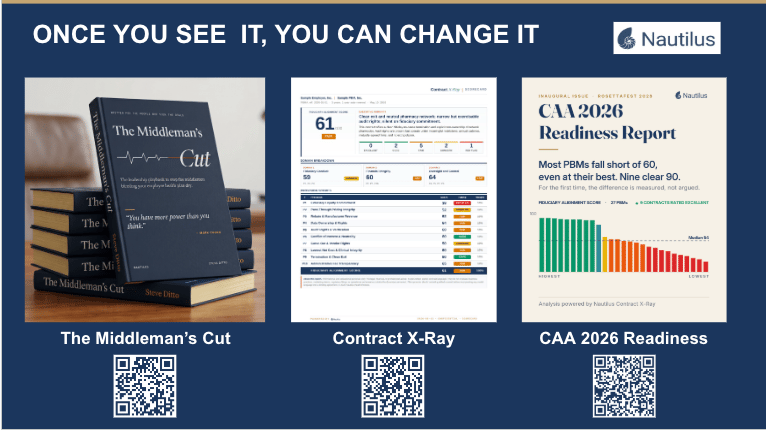
Mark Cuban inspired me to write The Middleman’s Cut. The book draws on his public comments, used with his permission. The Foreword is particularly compelling building the case for change. I’m including a free version for readers of this newsletter to download.
→ Download the Foreword
────────────────────────────────────────
Employers pay far more than they should to middlemen most executives have never heard of. Change the status quo and reap the benefits. Employers who act are recovering 20% to 30% of pharmacy spend, and returning it to wages and benefits.
Schedule an introductory call with us.