How employer decisions fuel pharmacy closures—and what you can do about it
Executive Brief
Independent pharmacies are disappearing—hurting employee care access and driving up long-term healthcare costs. PBMs are a big part of the problem. But health plans that authorize and enable their practices are part of it too.
This issue breaks down the risks, exposes the PBM playbook, and outlines practical steps employers can take to protect their people, reduce fiduciary risk, and restore trust.
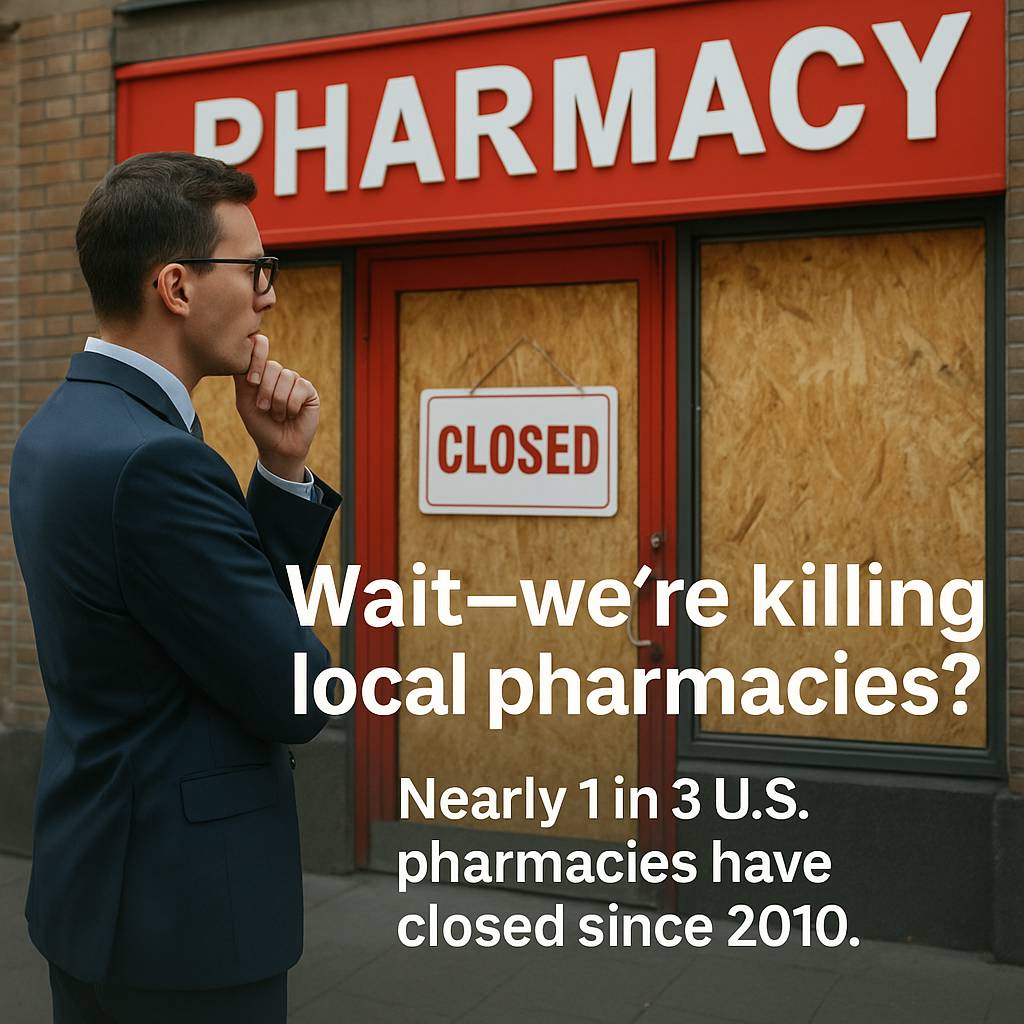
Nearly 1 in 3 U.S. retail pharmacies have closed since 2010. The vast majority of states are seeing a steady decline—and in many communities, the last local pharmacy has already shut its doors. The result is a growing pharmacy desert.
Growing Pharmacy Deserts
You didn’t set out to harm local pharmacies. But your health plan might be doing exactly that by enabling PBMs to put local pharmacies out of business.
What’s at Stake: Access, Trust, and Health Outcomes
Pharmacists aren’t just “pill counters.” Far from it. They’re:
Among the most trusted professionals in America (Gallup)
Often the only healthcare provider within miles for employees
Vital to chronic care teams—especially where PCP shortages exist
Essential to public health via vaccines, screenings, and education
Closing their doors doesn’t just hurt the business—it hurts the patient. And when patients can’t access timely care, your plan pays more later—in dollars and lives.
This isn’t just a retail story. It’s a care access crisis.
When care gets delayed, your plan—and your people—pay the price.
The PBM Playbook Driving Closures
So why are pharmacies disappearing?
Some blame government underpayments or declining retail profits. But increasingly, scrutiny is turning to the PBMs hired to “manage drug costs.”
The tactics are familiar—but devastating:
Patient Steering – Directing patients to PBM-owned “preferred pharmacies” and mail order
Below-Cost Reimbursement – Forcing pharmacies to dispense drugs at a loss
Spread Pricing – Charging your plan one price while reimbursing pharmacies far less
Clawbacks – Reclaiming payments from pharmacies after prescriptions are filled
This isn’t just margin management. It’s a rigged system. PBMs profit. Pharmacies vanish. Patients pay the price.
The good news? Employers have more leverage than they think—if they’re willing to use it.
The Employer’s Role—and Responsibility
Here’s what most fiduciaries don’t realize:
Your plan authorizes these practices.
You choose the PBM.
You sign the contract.
You allow the incentives that erode access.
Imagine contracting with a food service company—only to find out they also own the vending machines, charge your employees double for snacks, and quietly starve out local vendors. That’s how PBM ownership and steering works to harm local pharmacies.
If your PBM agreement allows steering, spread pricing, clawbacks, and PBM self-dealing, you’re not just “managing cost.” You’re weakening your care network, reducing access, and negatively impacting participant interests in ways you never imagined.
And under ERISA and the CAA, willful ignorance is not a defense.
Fortunately states are beginning to take action.
Case Study: Arkansas Takes a Stand
Rural pharmacy closures in Arkansas sparked legislative action. In April 2025, Governor Sarah Huckabee Sanders signed HB 1150, banning PBMs from owning pharmacies outright.
The message was clear: you can’t manage the network and profit from it.
CVS responded by announcing it would divest its retail pharmacies in the state—rather than exit the PBM business.
CVS didn’t flinch. They chose to abandon retail pharmacies—rather than give up control of their PBM cash machine. If that doesn’t highlight where the money is, nothing will.
The Arkansas case reveals how state leaders are stepping in where plan sponsors haven’t.
But employers don’t have to wait for legislators or regulators to act.
Instead, they can find transparent PBM alternatives who are pharmacy-friendly and take the role of protecting pharmacies seriously.
MedOne – A Pharmacy-Friendly PBM Alternative
A Transparent PBM Born from Independent Pharmacy Roots
MedOne RX
Founded by a group of independent pharmacists, MedOne was built to fix a broken system—without becoming part of the problem. From day one, the company chose a transparent, pass-through model and identical pricing for every client, eliminating the hidden margins and preferential deals that dominate the PBM industry.
And to avoid the conflicts of interest that now plague the market? They spun off their retail pharmacy holdings—by design.
“We started as an independent pharmacy, but we knew we couldn’t be both referee and player. So we separated the businesses—and built a PBM that treats all pharmacies fairly.” — Wes Hartig, CEO, MedOne
Unlike traditional PBMs that steer patients to their own pharmacies, MedOne maintains network neutrality—ensuring independent pharmacies get fair access, and employees get real choice. Their model focuses on lowering total plan spend, not gaming rebates.
For employers seeking cost control and fiduciary-aligned transparency while maintaining pharmacy access, MedOne offers a refreshingly principled alternative.
What Employers Can Do (Starting Now)
You don’t have to fix the system. Just stop fueling it.
Here’s how employers can flip the script—restoring access and aligning pharmacy benefits with fiduciary values:
🤝 Work With Transparent, Pass-Through PBMs
Align contract terms and pricing with both the plan and participant’s best interest
🔍 Audit Your PBM Contract
Avoid spread pricing, clawbacks, and ownership conflicts
📊 Request Pharmacy-Level Reimbursement Data
Compare what’s paid to local pharmacies vs chains and mail-order
📪 Require Network Access Parity
Don’t allow patient steering to in-house pharmacies
🏥 Support Local Pharmacies
Include independents in networks and educate employees on their availability
📍 Track Access as a Metric
Measure proximity, availability, and patient satisfaction
Final Word: Be Pro-Care, Not Pro-Conflict
You don’t have to be anti-PBM to be pro-patient.
But if your contract enables self-dealing and care erosion—your fiduciary duty demands a change.
Fixing this problem isn’t a pharmacy handout.
It’s compliance.
It’s strategy.
It’s access.
Because when the last pharmacy closes, your employees don’t lose convenience—they lose care.
Ready to Reclaim Control?
Better benefits start with smarter alternatives—and stronger contracts.
📩 Schedule your no-risk vendor evaluation today.
💸 SPECIAL OFFER: Newsletter subscribers receive 10% off any Validation Institute service. Use code FIDUCIARY10 at checkout.
validationinstitute.com
📬 PAY IT FORWARD: Feel free to forward this offer to your broker, PBM, or other vendors. Don’t hesitate to tell them you will favor validated vendors as part of your modernized procurement processes. Strong compliance and better benefits begin with validation.
Don’t be a bystander. Change the status quo and reap the benefits of The Health Plan Compliance Advantage.