Contract Provisions That Fail Most Often
What the Nautilus Database Shows
Executive Brief
Last week we introduced the Data Sovereignty Index.
This week we open the database to see how PBMs fare against it.
Twenty-three PBMs. Fifty-five contracts.
The numbers tell a story the marketing materials do not: rebate transparency has become table stakes, but control over your data, your audits, and your formulary remains rare.
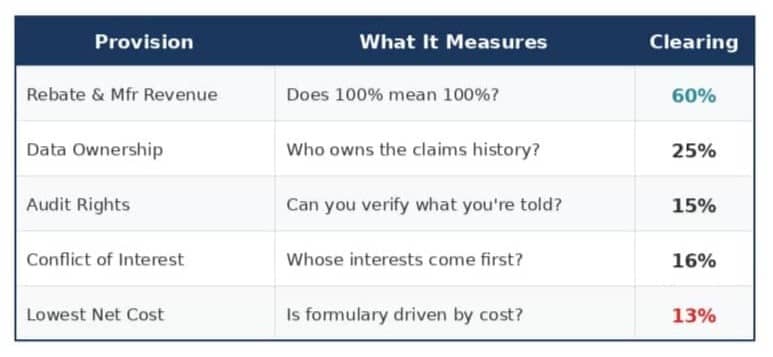
Sixty percent of contracts clear the rebate floor. Thirteen percent clear lowest net cost.
The gap between those two numbers is where plan sponsors lose control of outcomes they thought they were buying.
What Data Sovereignty Means
In international contexts, data sovereignty refers to digital information being governed by the laws of the country where it is collected or stored. The data conforms to the laws of the land.
In employer health benefits, the principle is the same. Your plan’s data representing claims, pricing, rebates, formulary decisions, etc. must conform to the laws that govern it: ERISA’s fiduciary duty and the Consolidated Appropriations Act’s transparency requirements.
That’s is why the Nautilus Fiduciary Alignment Score (FAS) sits at the foundation of the Data Sovereignty Index. The FAS measures whether a contract’s structure aligns with the legal obligations of a plan sponsor. It is the foundation beneath the floors.
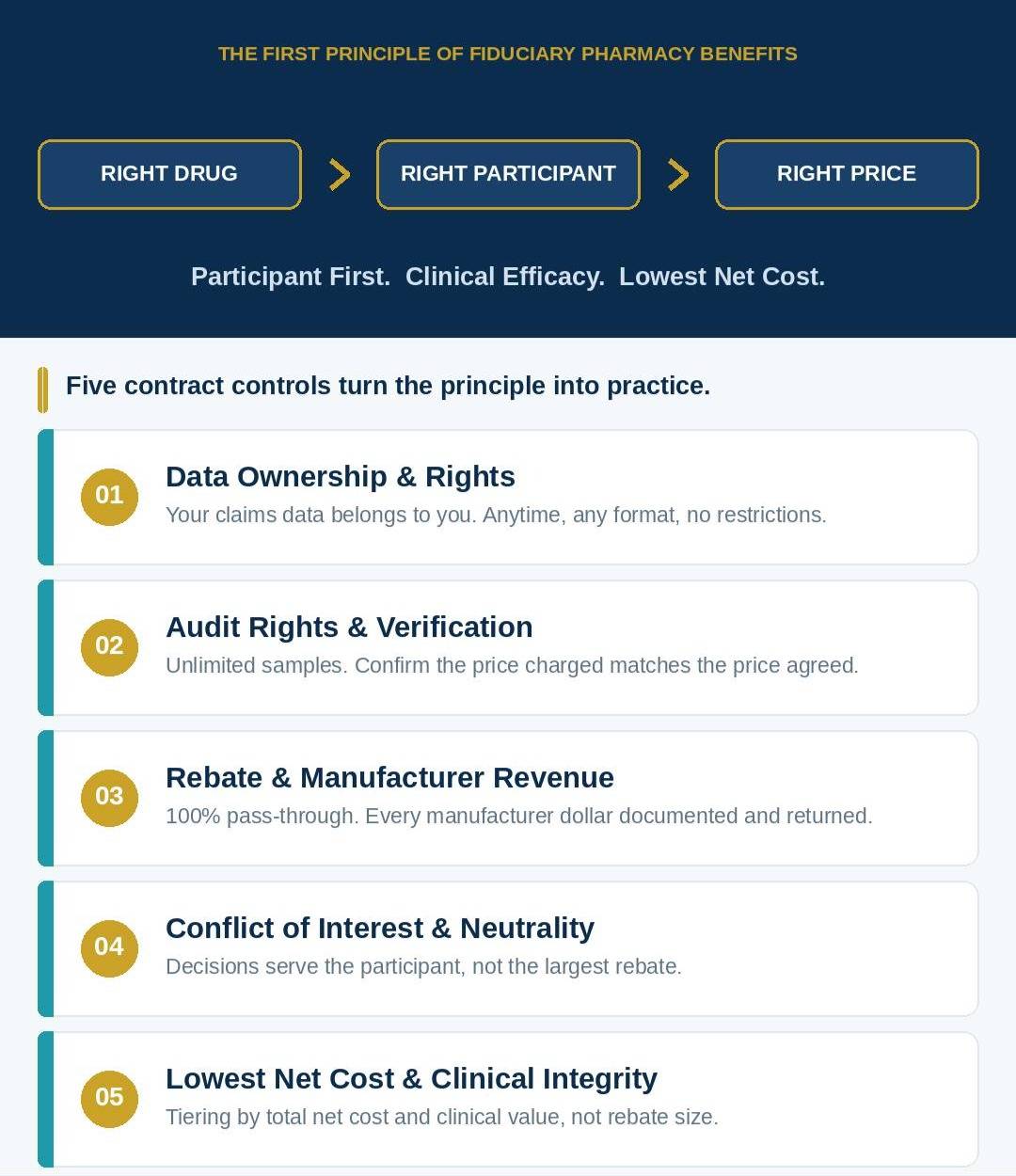
But compliance alone is not the goal. The goal is to achieve the first principle of pharmacy benefits: deliver the right drug to the right participant at the right cost.
You can’t achieve that outcome with access alone. Access means you can request your data. Control means you can use it to verify what you were told, to enforce what you were promised, and to prove the clinical and financial outcomes driven by the formulary are serving participants rather than serving the PBM’s revenue model.
First Principle of Pharmacy Benefits
Why These Five Provisions
Data sovereignty is not control for control’s sake. It exists to protect the outcome. You can’t get the right drug to the right participant at the right cost unless you can:
- Verify your formulary is optimized for lowest net cost, not for rebate revenue that benefits the PBM
- Confirm you are not losing plan assets to spread pricing, rebate retention, or hidden fees
- Ensure participants are not steered to high-cost affiliated pharmacies when lower-cost options exist
- Access your own data to validate what you are told
- Audit the results to enforce the promises you were made
Remove any one, and the chain breaks.
A contract that passes rebates through but restricts audit rights can’t prove what was passed. A contract with strong data ownership but weak lowest-net-cost language still allows formulary decisions that cost the plan more. A contract that clears four floors but fails one has a hole large enough to compromise the outcome you are paying for.
The FAS ensures the contract support fiduciary laws and obligations. The five provisions ensure you can achieve the outcome the laws exist to protect.
Data Ownership & Rights
What it measures: Who owns the data?
Why it matters: Data ownership determines whether you can use it to validate what you paid or share it with consultants and coalitions without restriction. A contract that grants the PBM ownership or limits your use rights makes every other protection harder to enforce.
What good looks like: The contract states all claims data belongs to the plan sponsor. The plan sponsor has unrestricted rights to use, transfer, and share the data during and after the contract term. No licenses back to the PBM that limit sponsor control.
Floor clearance: 25% Three in four contracts fail this floor. The data exists. Sponsors generated it. But the contract language gives control to someone else.
Audit Rights & Verification
What it measures: Can you verify what you’re told?
Why it matters: Every other promise in the contracts including rebates, pricing, lowest net cost, etc. depends on your ability to verify it. Audit rights that restrict timing, scope, auditor selection, or data access make verification impossible. A promise you cannot audit is a promise you cannot enforce.
What good looks like: The plan sponsor selects the auditor without PBM approval. Audits can occur annually without limit. The auditor receives full access to claims data, rebate data, and pharmacy network contracts. Findings can be extrapolated. Results can be shared with the board, counsel, and coalition partners.
Floor clearance: 15% Fewer than one in six contracts provide audit rights sufficient to verify what the PBM reports. The rest rely on trust.
Rebate & Manufacturer Revenue
What it measures: Does 100% mean 100%?
Why it matters: Rebates are the most discussed and least understood revenue stream in pharmacy benefits. A contract that promises “100% rebate pass-through” can still retain administrative fees, data fees, formulary placement fees, and performance bonuses, none of which appear in the rebate line.
What good looks like: The contract defines Manufacturer Derived Revenue to include all compensation from manufacturers, not just volume-based rebates. The pass-through percentage applies to the comprehensive definition, not a narrow one.
Floor clearance: 60% This is the strongest showing of the five dimensions. The market has moved. But three in five clearing is still two in five that do not.
Conflict of Interest & Neutrality
What it measures: Whose interests come first?
Why it matters: The largest PBMs own specialty pharmacies, mail-order pharmacies, and rebate aggregation businesses. When the PBM’s affiliated entities benefit from steering, the plan sponsor’s interests and the PBM’s interests diverge. A neutrality provision requires the PBM to act in the plan’s interest even when that conflicts with affiliate revenue.
What good looks like: The contract includes an express fiduciary or fiduciary-like standard. The PBM discloses all affiliate relationships and recuses affiliates from formulary and network decisions where conflicts exist. Compensation from affiliates is treated the same as compensation from unrelated parties.
Floor clearance: 16% Five in six contracts do not require the PBM to put the plan’s interests first when affiliate revenue is at stake.
Lowest Net Cost & Clinical Integrity
What it measures: Is the formulary driven by cost or revenue?
Why it matters: Lowest net cost means the formulary steers participants to the drug that costs the plan the least after rebates, not the drug that generates the most rebate revenue. Without this provision, the PBM’s incentive is to favor high-list, high-rebate drugs over lower-cost alternatives.
What good looks like: The contract includes an express lowest-net-cost commitment. The PBM must demonstrate that formulary placement reflects total cost to the plan, not gross rebate value. Clinical exceptions exist for therapeutic necessity, but the default is cost-to-plan, not revenue-to-PBM.
Floor clearance: 13% This is the weakest showing of the five dimensions. Fewer than one in seven contracts require the PBM to prioritize lowest net cost. The rest allow formulary decisions that optimize rebate revenue at the plan’s expense.
Provision Floor Clearance
The Pattern Underneath
Business model predicts the result. No traditional spread-pricing contract in the database earned any DSI designation.
Every contract that qualified for Bronze, Silver, or Gold came from a pass-through, fiduciary-aligned PBM.
The structure a PBM starts from shapes what its contracts protect. A PBM built on spread pricing has no incentive to write strong audit rights or lowest-net-cost guarantees. The contract reflects the business model.
Three Ways to Use DSI in Procurement
The DSI is most valuable when it changes a decision. Three patterns guide how plan sponsors can use it well:
1. Set a minimum tier in RFP scoring. Require DSI Silver or higher as a baseline qualifier. This filters proposals on contract structure before evaluating pricing. It signals to incumbents that data sovereignty is non-negotiable.
2. Measure tier progress year over year. A DSI Bronze contract is not a failure. It is a starting point with a visible improvement path. Sponsors who re-score annually create documented progress: Bronze to Silver, Silver to Gold. The designation becomes a fiduciary record.
3. Translate the designation for the board. The board does not need to understand the per-provision mechanics. A short summary works: this contract meets (or does not meet) DSI Silver criteria, which means the plan sponsor can (or cannot) demonstrate that data sovereignty protections exist in writing across all five dimensions.
What to Do First Thing Monday
- Pull your current contract. Find the sections covering rebates, data ownership, audit rights, conflicts of interest, and formulary management. Read them with the floor criteria in mind.
- Submit your contract for scoring. Email support@nautilushealth.org. A Contract X-Ray analysis includes the DSI designation and identifies the specific language changes required to improve.
- Compare to the floor clearance rates. Your contract either clears each floor or it does not. Knowing which provisions fall short tells you where to focus negotiation.
- Ask your PBM for a DSI response. Request a written response showing how their contract language addresses each of the five provisions. If they can’t answer, that is information worth having.
In Closing
Data sovereignty is not a marketing claim. It’s five contract provisions, each with a floor, each measurable.
Sixty percent clear rebates. Thirteen percent clear lowest net cost. The gap between those numbers is where control disappears.
The path to Data Sovereignty is there. The question is whether you will walk it.
Here’s to clearer thinking, stronger plans, and better outcomes for the people who rely on us.
All the best,
P.S. Next week: The rebate float. Your PBM collects rebates and generates float until they pay you. That gap has a cost and most plan sponsors have never calculated it.
Subscribe & Share
🔗 Subscribe: Was this newsletter forwarded to you? Signup to receive The Health Plan Compliance Advantage every Monday.
📤 Share: Know someone reviewing a PBM contract? Forward this issue.
💸 SPECIAL OFFER: Newsletter subscribers receive 10% off any Validation Institute service. Use code FIDUCIARY10 at checkout.
────────────────────────────────────────
Don’t be a bystander. Change the status quo and reap the benefits of The Health Plan Compliance Advantage. Schedule an introductory call with us.