“Most employers have little idea what the pharmacy benefit managers (PBMs) they hire do with the money they exchange for the medications used by their employees.”
– KFF survey of 2,142 companies
Nearly half of executives admit they don’t fully understand PBM contracts, even though they’re legally responsible for them.
This isn’t just ignorance—it’s personal risk. Courts have ruled employers are fiduciaries under ERISA. That means executives, boards, and health plan managers carry personal liability for opaque contracts that harm participants.
The bottom line? The people with the power to fix PBMs often don’t realize they’re accountable. That has to change—and fast.
The Problem: Blindly Signing Contracts
Executives approve multi-million-dollar PBM deals with less scrutiny than a copier lease. Why?
Complex & opaque contracts designed to confuse.
Conflicted brokers earning hidden commissions.
Fiduciary duties ignored—until the lawsuits arrive.
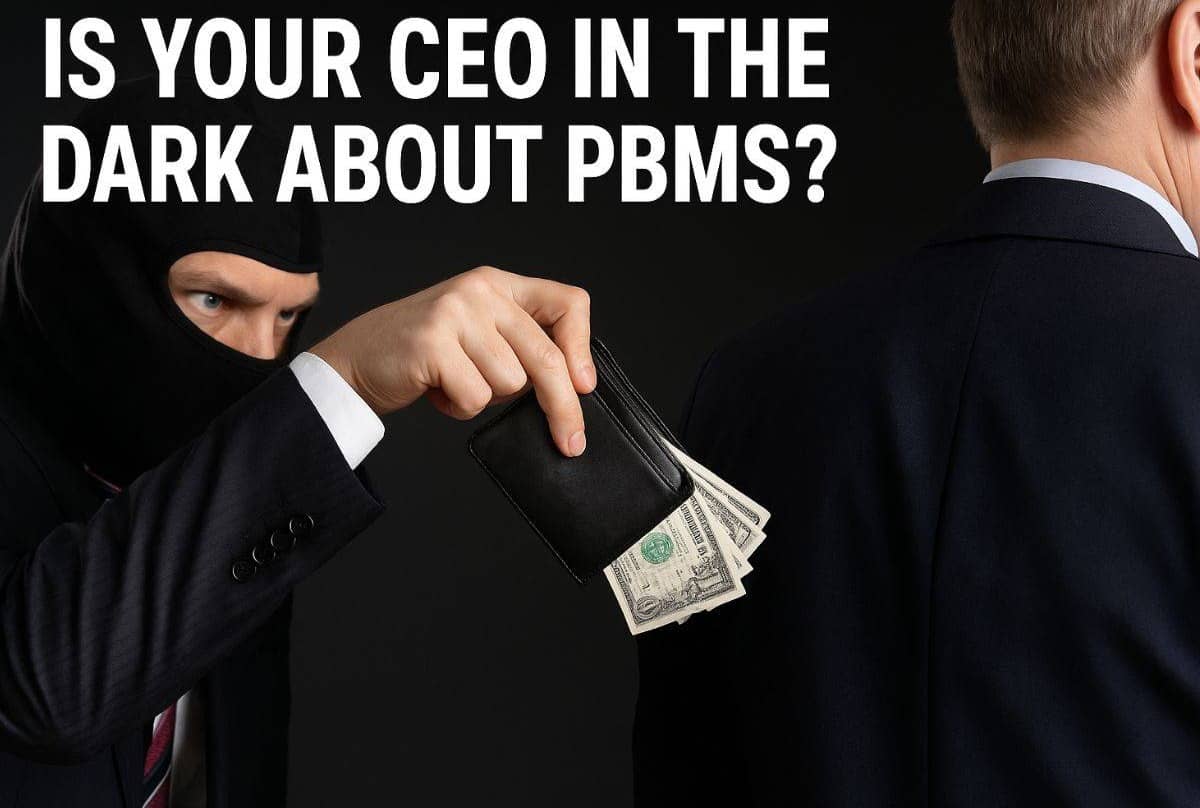
When you’re not watching its easy to get your pocket picked.
Is Your CEO In The Dark About PBMs?
Where to Start: A Plain-English FAQ
As part of the Nautilus PBM Field Guide, we compiled a PBM FAQ for Executives—a no-nonsense guide to arm CEOs, CFOs, and board members with the questions that cut through the fog:
Why are employers being sued over PBM contracts?
What’s the truth about rebates?
Which provisions must be in every PBM contract?
Why should audit and data rights be non negotiable?
PBMs profit when leaders stay in the dark. It’s time to turn on the lights.
Here are 20 essential questions (and straight answers) executives need to cut through PBM confusion, uncover hidden risks, and take back control.
PBM FAQ for Executives
1. What is a PBM and why should employers care?
PBMs administer prescription drug plans. They control access, pricing, and pharmacy reimbursements. Yet they often operate with minimal transparency, impacting plan costs and participant outcomes.
2. How concentrated is the PBM market?
Three PBMs—CVS Caremark, Express Scripts, and OptumRx—control over 80% of the market. Their dominance limits competition and transparency that often drive up employer costs.
3. Why are employers being sued over PBM contracts?
Lawsuits allege employers failed to monitor PBM practices and allowed excessive costs. Courts increasingly view employers as ERISA fiduciaries with personal and organizational liability.
4. Are brokers and consultants trustworthy guides?
Not always. Many receive hidden commissions or bonuses from PBMs, creating conflicts of interest. Federal law now requires disclosure—but employers must demand and verify it.
5. What is ‘spread pricing’ and why is it a problem?
Spread pricing occurs when PBMs charge the plan more than they reimburse pharmacies. The PBM keeps the difference—creating incentives to maximize spread rather than control costs.
6. What’s the deal with rebates?
Rebates from drugmakers often go to PBMs instead of the plan. They inflate list prices and incentivize high-cost drugs over lower-cost alternatives. Employers should demand 100% rebate pass-through.
7. What is ‘carving out’ the PBM, and why does it matter?
Most PBMs are bundled with your medical carrier or TPA. Carving out means selecting an independent PBM using fiduciary criteria to ensure transparency, competition, and oversight.
8. What is the First Principle: Right Drug > Right Participant > Right Price?
It means plans must prioritize clinical appropriateness first, then equitable access, then cost. Cutting corners or chasing rebates can harm participants and violate fiduciary duties.
9. What are the six pillars of a fiduciary-aligned PBM?
1) Clinical Stewardship, 2) Full Financial Transparency, 3) Unconflicted Procurement, 4) Data Ownership, 5) Local Access & Provider Fairness, 6) Attestation & Oversight.
10. Can PBMs be fiduciaries?
Yes. If they exercise discretion over plan assets such as setting pricing or denying claims. The better position may be to find a PBM who wants to be “fidcuiary-aligned” by agreeing to work in the best interest of participants and beneficiaries.
11. Are employers required to monitor their PBM?
Absolutely. ERISA requires prudent oversight of all vendors, including PBMs. Ignorance is not a defense—and documentation of your oversight is essential.
12. What should employers demand in a PBM contract?
Clear definitions, full data access, audit rights, 100% rebate pass-through, no spread pricing, and performance guarantees. Ambiguous terms cost money—and invite lawsuits.
13. What is the ‘lowest net cost’ approach?
Instead of chasing rebates, fiduciaries must evaluate drugs based on total cost to the plan—after discounts, rebates, and fees. High rebates don’t always mean lower net costs.
14. How can employers run a fiduciary-aligned RFP?
Use open-source RFP templates with clearly defined requirements. Include scorecards, contract terms, and evaluation rubrics that align with fiduciary best practices.
15. How much do PBMs make—and how do they get paid?
Many PBMs profit from hidden markups, rebate retention, and spread pricing. True fiduciary-aligned PBMs earn a flat fee. If you can’t follow the money, you’re likely overpaying.
16. What’s the role of data in PBM oversight?
If you don’t have full claims and pricing data, you can’t verify compliance or performance. Fiduciary oversight requires independent analysis—not trust.
17. What is the Nautilus PBM Configurator?
It’s a tool that lets advisors and employers customize their procurement process, evaluate vendors, and compare responses—saving time while enforcing fiduciary standards.
18. What’s the downside of doing nothing?
Rising costs, poor outcomes, fiduciary risk, and reputational exposure. Courts are clear: silence or inaction is not a defense. If your plan is opaque, you may already be liable.
19. How can employers start fixing this problem?
1) Educate fiduciaries. 2) Demand contract transparency. 3) Launch a Contract Compliance RFI. 4) Review rebate flows and pricing. 5) Document your decisions.
20. What if our broker resists PBM changes?
Ask who pays them. Demand full compensation disclosure. If it’s the PBM, not you—they’re conflicted. Fiduciaries must prioritize plan participants, not broker convenience.
Key Takeaway
The PBM model isn’t broken—it’s working exactly as designed. The problem is, it wasn’t designed for you.
Executives have the power—and the duty—to flip the script:
Become informed
Ask hard questions
Demand transparency
Reject conflicts
Insist on fiduciary-aligned contracts
When leaders are informed the result is stronger compliance, better benefits, sustainable savings, and healthier employees.
What You Can Do This Week
Forward this newsletter to your CEO, CFO, or benefits committee chair. Don’t wait for a lawsuit to make them care.
Issue a Contract Compliance RFI using the PBM Configurator and model contract language to test whether your PBM is willing to meet legal and fiduciary standards.
Compare the answers to challenger PBMs who are already aligned and often 20–30% cheaper.
Visit nautilushealth.org/pbmto find educational resources, procurement tools, model contract terms, the PBM Configurator, and other tools.
Launch Bonus: 1-on-1 Help — Free for Subscribers
Need a jumpstart? As a newsletter subscriber, you get free access to the tools—and our help using them. We’ll:
Send the Contract Compliance RFI
Review the PBM’s responses with you
Help frame next steps for your team
No sales pitch. No pressure. Just results.
Just hit reply with one sentence: “I’m ready to issue the RFI.”
We’ll handle the rest.
A Note of Thanks
Dr. Randy Vogenberg
Randy Vogenberg has over three decades of experience as a strategic healthcare leader. As the co-host of the Only Healthcare podcast, Randy recently interviewed Steve Ditto and Dave Chase about Breaking the Healthcare Monopoly. Randy was a valuable contributor and editor of the PBM Field Guide.
Also, deep gratitude to everyone who built this toolkit: Nautilus and Health Rosetta leadership, expert advisers, and PBMs committed to transparency.
Explore the model PBM contract language and apply for early access to the Nautilus PBM Configurator at: 🔗nautilushealth.org/pbm
💸 SPECIAL OFFER: Newsletter subscribers receive 10% off any Validation Institute service. Use code FIDUCIARY10 at checkout.
validationinstitute.com
📬 PAY IT FORWARD: Feel free to forward this offer to your broker, PBM, or other vendors. Don’t hesitate to tell them you will favor validated vendors as part of your modernized procurement processes. Strong compliance and better benefits begin with validation.
Don’t be a bystander. Change the status quo and reap the benefits of The Health Plan Compliance Advantage.