Here’s the uncomfortable truth: Many of the problems plaguing employer health plans are compliance failures rooted in weak procurement practices.
In a market dominated by vertically integrated giants, it’s likely your organization has signed multiple health plan contracts that overpay by millions—without transparent pricing, data access, audit rights, or accountability. Staying with the status quo may feel safe. It’s not.
A big part of the problem in healthcare: it’s not just one wolf in sheep’s clothing. It’s more like you’re in a field of them.
Procurement in healthcare isn’t just difficult—it’s conflicted. Many brokers and vendors operate with incentives that don’t align with your duty to plan participants.
The good news? A new class of vendors is emerging. Many of these vendors are not just alternatives—they are principled challengers. Many are:
Transparency First: Treating transparent pricing, pass-through models, and simplified contracts as table stakes—not perks.
Third-Party Verified: Certifying their contract terms, savings, and outcomes through independent groups like the Validation Institute.
Standards-Based: Adopting standardized contracts from Health Rosetta—much like the AIA did for construction—to reduce ambiguity and risk.
Mission-Aligned: Organized as Public Benefit Corporations (PBCs), prioritizing societal impact over shareholder returns.
You have viable options. But to make the best choices you need to follow a structured, repeatable procurement process.
Use the framework below to take you from start to a successful finish with a prudent, disciplined process.
Fiduciary-Compliant Procurement Framework
As a fiduciary, your role isn’t just to make safe choices—it’s to make prudent, loyal, and well-informed ones. That means having a clear, disciplined process for evaluating benefit design decisions in the best interest of participants and beneficiaries.
This five-stage Fiduciary-Compliant Procurement Framework can guide the process:
Stage 1: Strategy & Planning
Goal: Clarify purpose and set objectives.
Key Actions:
Define Needs: Clearly outline the needs, goals, and expected outcomes for both the plan and participants.
Establish Baseline: Use contracts and claims data to establish a current performance baseline and inform objectives.
Benchmark: Compare the baseline against industry and peer organizations.
Identify Success Factors: Determine key success factors such as cost, quality, access, and innovation.
Establish Governance: Define roles, decision-makers, advisors, and fiduciary oversight within a governance model.
Set Methodology & Timeline: Establish a methodology (e.g., RFx, reverse auction, direct sourcing) and a timeline for the process.
Engage Experts: Decide whether to bring in independent experts to ensure prudent decisions and a disciplined process.
Stage 2: Market Scanning & RFI
Goal: Understand the market landscape and differentiators.
Key Actions:
Issue RFI: Distribute a Request for Information (RFI) to a broad group (10+ vendors).
Structured Questionnaire: Assess vendor capabilities and willingness to support contract terms, audits, validation, or guarantees
Goal: Separate marketing claims from reality and validate what matters.
Key Actions:
Downselect: Reduce the list to 2–3 finalists.
Detailed Review: Assess capabilities, contract terms, SLAs, and guarantees
Conduct Diligence: Interview implementation and account teams, perform site visits, check client references
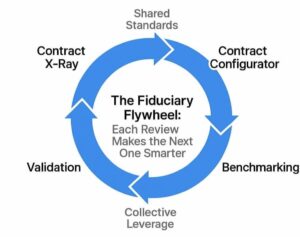
Validation – Request third-party confirmation of outcomes and savings.
Stage 5: Decision, Contracting & Transition
Goal: Select the best-fit vendor and ensure accountability post-selection.
Key Actions:
Documentation: Officially document the selection process and rationale (for board/legal/Fiduciary Committee).
Negotiate Contract: Focus on clarity of pricing and savings mechanisms, performance guarantees and penalties, data ownership and access, exit rights and portability
Implementation Plan: Prepare a detailed implementation roadmap and communication plan.
Monitoring: Establish performance dashboards, audit schedules, and feedback loops.
This framework can be applied across all major benefit areas—PBMs, TPAs, stop loss, direct contracting with providers, and specialty solutions. The goal remains the same: to make decisions that are prudent, evidence-based, and aligned with the best interest of participants and their beneficiaries.
De-Risk Through Validation
Some might consider it risky to avoid the industry “leaders” to find solutions from smaller independent vendors in the remainder of the market. But there are ways to de-risk that decision and find independent vendors who share your desire for competitive pricing, transparent solutions, and a trusted relationship. When selecting new vendors it always helps to have an expert, independent opinion.
One source of help in the healthcare vendor procurement process is the Validation Institute. Their mission aligns with ours: Empowering purchasers to control health care spend and transform health benefits.
The Validation Institute helps de-risk the vendor selection process by independently verifying their marketing claims. Their validation includes:
🔍 Contract review for transparency and red flags
📉 Independent analysis of claimed savings
💊 Expert validation of program outcomes
And the kicker? They back it up with a Credibility Guarantee of $25,000–$100,000.
validationinstitute.com
📬 Feel free to forward this offer to your broker, PBM, or other vendors. Don’t hesitate to tell them you will favor validated vendors going forward. Strong compliance and better benefits begin with validation.
What You Can Do Next
Our standing advice to all employers is to immediately evaluate your pharmacy benefits. It’s usually the lowest hanging fruit to improve compliance, reduce costs, improve benefits, and satisfy your employees.
✅ If you’re an employer: Use the Fiduciary-Compliant Procurement Framework and prioritize validated vendors in your process
✅ If you’re an advisor: Become validated to create viable differentiation to traditional brokers and build trust with employers
✅ If you’re a PBM: Become validated to create viable alternatives to the Big 6 PBMs and increase your credibility with validated marketing claims
Let’s build a future where fiduciary duty and outstanding benefits go hand in hand—with accountability at the center.
Conclusion
Small Wins Build Big Momentum:
🔍 Use the Framework to review vendors (perfect timing for 2026)
💸 Encourage vendors to to get Validated (use code FIDUCIARY10)
🎯 Improve compliance and savings (for the plan and participants)
Ready to shift from default to deliberate? Let’s talk.
Don’t be a bystander. Change the status quo and reap the benefits of The Health Plan Compliance Advantage.