Executive Brief
Here’s a question benefits advisors are not asking often enough:
If your client gets sued over their PBM contract, what will discovery reveal about your role?
The Schlichter playbook for plaintiffs is now established. The lawsuits name the employer. Discovery follows the paper trail backward: who was in the room during selection, who recommended the terms, who blessed the renewal. That trail leads to you as the advisor.
This is the discoverability problem. Not whether you did anything wrong. Whether what you did is documentable, defensible, and aligned with an objective standard that existed at the time.
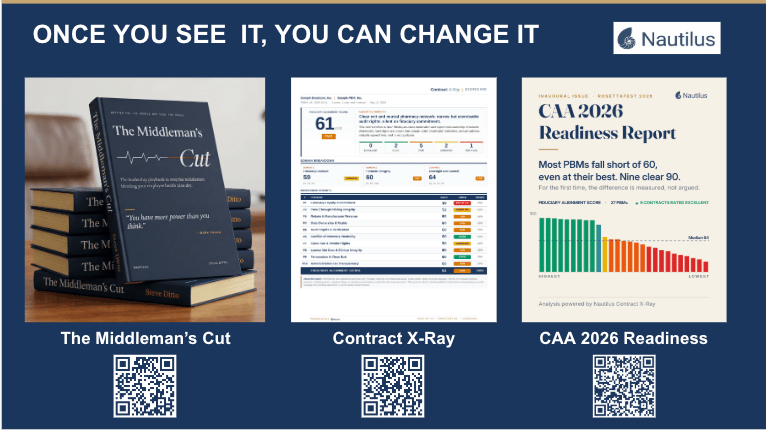
The Contract X-Ray 90 Standard changes the calculation. When contracts scoring 90 or above are readily available across the market, recommending or endorsing a contract scoring 42 becomes harder to explain. Not because you’re negligent. Because the gap is now measurable, documented, and discoverable.
The good news: the same tool that creates exposure also creates protection. Contract X-Ray gives you an objective record of what you recommended, why, and how it compared to market standards. That’s the documentation trail you want plaintiff’s counsel to find.
The Discovery Playbook
The plantiff’ firm’s approach to pharmacy benefit litigation follows a predictable pattern. The lawsuit names the employer and plan fiduciaries. Discovery requests follow. Those requests include:
- All communications related to PBM selection and renewal
- All analyses, recommendations, and reports from advisors
- All contract negotiations and term comparisons
- All documentation of fiduciary process
The advisor isn’t named as a defendant. But your recommendation memo becomes an exhibit. Your renewal analysis becomes evidence. Your compensation disclosures become discoverable.
Meanwhile, the Schlichter firm has opened a second front. In late 2025, they filed suits against major benefits consultants in the voluntary benefits space, alleging excessive commissions, undisclosed compensation, and self-dealing. Mercer, Gallagher, Lockton, Willis Towers Watson: named as defendants, not witnesses.
That playbook hasn’t reached PBM yet. But the theory translates directly.
The Defensibility Gap
Here’s where the math gets uncomfortable.
Contract X-Ray has now scored contracts representing dozens of employers across multiple market segments. The data is clear:
- 10+ PBMs consistently produce contracts scoring 90 or above
- Pass-through models average scores above 90
- Spread-priced models average scores in the 20s
- The Big Three PBMs average 24
When an employer asks why they’re paying $1,800 PMPY when comparable employers pay $800, “we got the best deal available” no longer holds. The data says otherwise.
For advisors, this creates a specific problem. If you recommended a contract scoring 42 when contracts scoring 90+ were available from multiple carriers, the question becomes: what analysis led to that recommendation?
If the answer is “that’s who the employer was already using” or “that’s who offered the biggest rebate check,” the documentation doesn’t help you. It hurts you.
Who’s in the Room
In the current wave of PBM litigation, advisors aren’t defendants. They’re witnesses whose work product becomes evidence.
But the voluntary benefits suits show the next step. Schlichter’s theory: advisors exercising discretion over recommendations are functional fiduciaries, regardless of contract language. The breach claims focus on compensation:
- Undisclosed dual compensation: Fees from employers plus commissions from carriers.
- Self-dealing: Recommending higher-cost options that maximize advisor compensation.
- Failure to disclose alternatives: Withholding information about lower-cost options.
For PBM advisors, the translation is direct. If your compensation is tied to the incumbent PBM, and you recommend renewal of a contract scoring 42 when alternatives score 90+, the same theory applies.
CAA 2026’s covered service provider rules require disclosure of all direct and indirect compensation. That disclosure is now part of the paper trail.
Don’t Sign Stupid Contracts
Cristy Gupton, a Health Rosetta advisor, summarized the advisor’s obligation in five words: “Don’t sign stupid contracts.”
It’s funny because it’s true. And until recently, it was also unhelpful. What made a contract stupid? How would you know before you signed it?
Contract X-Ray makes that advice operational. A contract scoring 42 when 90+ is available? That’s a stupid contract. A contract with no unrestricted audit rights when 10 PBMs offer them? Stupid. A contract that forfeits earned rebates on termination when alternatives don’t? Stupid.
The 90 Standard isn’t legal jargon. It’s the line between smart and stupid, documented.
The Shield and the Sword
Here’s what changes when you can measure it.
The Shield: Document your due diligence using an objective, third-party scoring framework. When you recommend a PBM, include the Contract X-Ray score in your recommendation memo. When you renew an incumbent, document why the score is acceptable or what remediation you’ve requested. Build the record you want discovered.
The Sword: Use the standard to drive better outcomes. Tell your clients: “Any buyer of any size in any sector can and should demand contracts scoring 90 or above. That’s the market standard.” Then deliver on it. The 90 Standard isn’t aspirational. It’s achievable today.
The advisors who adopt this approach early will have the strongest documentation when the litigation arrives. The advisors who continue recommending low-scoring contracts will have explaining to do.
The Compensation Question
One more consideration for advisors: how you’re paid affects how your recommendations look in discovery.
If your compensation is tied to the incumbent PBM through contingent commissions, revenue-sharing, or override arrangements, recommending renewal of a low-scoring contract looks different than if you’re paid flat fees by the employer.
CAA 2026 requires disclosure of advisor compensation to ERISA plans. That disclosure requirement is already in effect. If you’re collecting compensation from a PBM whose contract scores 28 while alternatives score 90+, the disclosure creates a documentation problem.
This is not a conflict-of-interest argument. It’s a discoverability argument. What will the paper trail show about who was paying you and what you recommended?
What to Do First Thing Monday
- Run Contract X-Ray on your largest client’s current PBM contract. Know the score before renewal conversations begin. If it’s below 90, you need a plan for remediation or transition. If it’s above 90, you have documentation of a sound recommendation.
- Draft a standard recommendation memo that includes Contract X-Ray scoring. Build the framework now. “Based on Contract X-Ray analysis, the proposed contract scores [X] against the fiduciary standard. This compares to market alternatives scoring [Y]. Our recommendation is based on [factors].”
- Review your compensation arrangements with each PBM you recommend. Under CAA 2026’s covered service provider rules, you must disclose all direct and indirect compensation. Document those disclosures. Ensure your recommendations align with your client’s interests, not your compensation structure.
- Brief your clients on The 90 Standard before their next renewal. Position the standard as the market expectation. “Contracts scoring 90+ are available from multiple carriers. That’s the benchmark we’ll use in your next procurement.”
In Closing
Scrutiny is coming. The playbook is established. The paper trail will be discovered.
The question for advisors is not whether to prepare, but how. The 90 Standard gives you an objective benchmark that exists today, not a standard plaintiff’s counsel will invent after the fact. Use it to document your diligence before discovery demands it.
Plan participants don’t know what fiduciary governance is. They know whether their prescriptions are affordable and whether their plan serves them well. Your documentation may never matter to them. But if it does, you want it to tell the right story.
You choose who you do business with. You choose the terms. Nothing under 90.
Here’s to clearer thinking, stronger plans, and better outcomes for the people who rely on us.
All the best,
P.S. Next week: the employer’s side of this same conversation. What should plan sponsors expect from their advisors, and how should they document the advice they receive? Two sides of the same paper trail.
────────────────────────────────────────
Subscribe & Share
🔗 Subscribe: Was this newsletter forwarded to you? Signup to receive The Middleman’s Cut every Monday.
📤 Share: Know someone reviewing a PBM contract? Forward this issue.
Tools and Resources
Mark Cuban inspired me to write The Middleman’s Cut. The book draws on his public comments, used with his permission. The Foreword is particularly compelling building the case for change. I’m including a free version for readers of this newsletter to download.
→ Download the Foreword
────────────────────────────────────────
Employers pay far more than they should to middlemen most executives have never heard of. Change the status quo and reap the benefits. Employers who act are recovering 20% to 30% of pharmacy spend, and returning it to wages and benefits.
Schedule an introductory call with us.