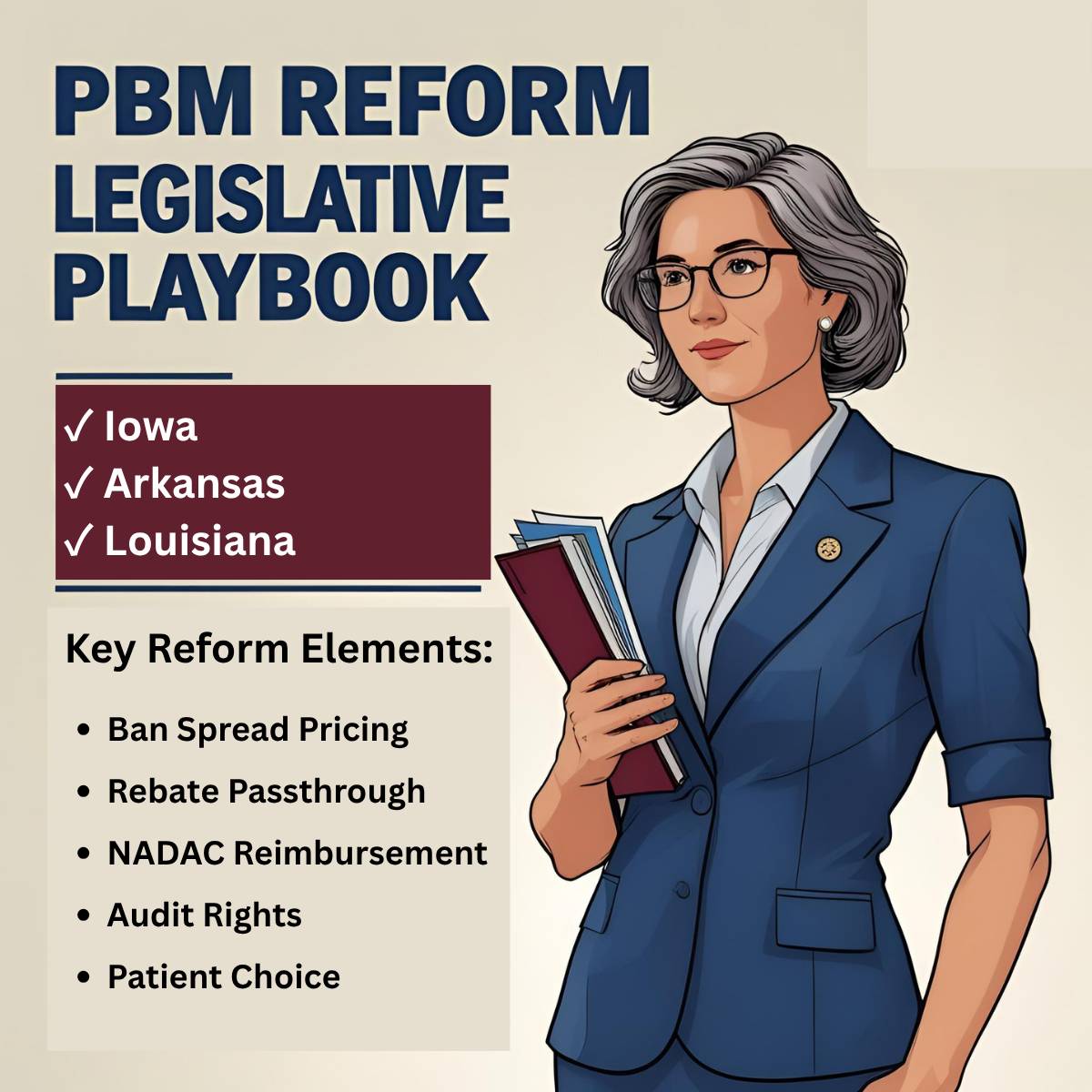
State legislatures are cracking down on PBM profit games—banning spread pricing, requiring rebate passthrough, and protecting patient access. The laws vary, but the best ones share a common DNA. Together, they form a de facto playbook for fiduciary-aligned pharmacy benefits.
The big takeaway? You don’t need to wait for a new law to act like one applies. You can—and should—start adopting the best parts now.
Reform is a mindset, not a mandate.
The Statehouse Is Where It’s Happening
The most meaningful PBM reforms in America aren’t coming from Washington.
They’re coming from places like Iowa and Arkansas—where lawmakers aren’t just talking about transparency, they’re legislating it.
Iowa passed sweeping reforms: pass-through pricing, a ban on rebate retention, and a $10.68 dispensing fee to support pharmacy access.
Arkansas outlawed PBM ownership of pharmacies—a direct strike at vertical integration and self-dealing.
More states are following their lead.
And smart employers are already using these laws as a blueprint for fiduciary-aligned pharmacy benefits—grounded in transparency, stewardship, and participant-first contracting.
What The States Are Telling Us
Across the country, state PBM laws are converging on a set of core protections—measures prioritizing patients over profits and empowering fiduciaries.
Here’s what the best state laws have in common:
Ban spread pricing: PBMs must eliminate hidden markups on what they pay pharmacies vs. what they charge health plans
Prohibit rebate retention: 100% of manufacturer rebates and fees go to the plan—not the middleman
Use NADAC-based reimbursement: Ensures pharmacies are paid fairly using a transparent, benchmarked pricing source
Set minimum dispensing fees: Especially important for sustaining independent and rural pharmacies
Prevent generic drugs from being misclassified as specialty: Stops PBMs from inflating costs by misclassifying cheap generics
Guarantee audit rights and full claims data access: Empowers plans to verify invoices and hold PBMs accountable
Ban gag clauses and restrict coercive steering: Patients can access the pharmacy that meets their needs—not just the one that boosts PBM profits
If you stitched together the best of these laws, you’d have a procurement policy stronger than most Fortune 500s.
State Laws Vary—But The Message Is Clear
State PBM Reform Status
Each law differs in scope, strategy, and enforcement—but together they point in the same direction.
The blueprint is clear:
Patient-first protections: Anti-steering, no formulary manipulation
Transparent pricing: No spread pricing, rebate and fee passthrough
Taken together, these state-level policies form a de facto template for fiduciary-grade pharmacy benefits.
Controversies And Critiques
Not everyone is cheering for state-level PBM reform. Critics have raised a mix of valid concerns—and self-serving objections:
Cost-shifting fears – Some claim dispensing fees will raise costs for employers or employees. But with the right plan design, the net effect is often savings—not cost increases.
Pharmacy protectionism – Critics say dispensing fees are a hidden tax to support outdated retail models. But in many areas, those pharmacies are the only access point for counseling, vaccines, and emergency fills.
PBM divestment fallout – Forcing PBMs to divest pharmacy ownership may trigger closures that create short-term disruption. Longer term they untangle the conflict of interest that undermines patient access and trust.
Our Take: Pharmacies Are Public Health Infrastructure
You don’t have to love every pharmacy. And it’s possible to have too many in some places.
But your plan, your employees, and their families depend on them.
And you should care whether they survive.
Pharmacies aren’t just pill dispensers—they’re healthcare access points, especially in communities without enough doctors, clinics, or urgent care centers. Treating them like commodity retail locations ignores what the data actually shows:
Pharmacists Reduce Hospitalizations and Costs
Studies show that embedding pharmacists into primary care teams can significantly reduce hospital readmissions, lower ER utilization, and generate hundreds of dollars in cost savings per intervention.
Medication-related problems are one of the top causes of avoidable hospital visits—and pharmacists are trained to catch them early.
Pharmacists Help Relieve the Physician Shortage
In rural and underserved areas, pharmacists are often the most accessible healthcare professional.
States like Idaho and Colorado now allow pharmacists to prescribe and manage chronic conditions under “standard of care” frameworks—expanding access to care.
Pharmacists Can Manage More Than Meds
Under Collaborative Practice Agreements (CPAs), pharmacists are already managing hypertension, diabetes, asthma, and more—adjusting therapy, ordering labs, and tracking outcomes.
In team-based care models, pharmacists aren’t backup—they’re co-pilots.
Pharmacist-Prescriber Collaboration
So Why Aren’t We Paying Pharmacists That Way?
Many state reforms now tie pharmacy reimbursement to NADAC + a professional fee, modeled after Medicaid. That’s a good start—but it doesn’t go far enough if we want to sustain access and elevate care.
Here’s what forward-looking programs are testing:
Rural access incentives: provide enhanced fees for pharmacies in underserved areas
Telepharmacy pilots: keep patients local even when the pharmacist is remote
Value-based payments: reward outcomes, not volume
Pharmacies are more than brick and mortar.
We should build more bridges to them—not burn them down.
Benjamin Franklin consistently argued private citizens and organizations should contribute to public goods because everyone benefits when the community thrives. He enthusiastically helped raise funding for schools, fire departments, and hospitals. As he might put it:
Good citizenship means supporting institutions that serve the whole community.
This Is About Fiduciary Duty, Not Legislation
Waiting for legislation means waiting for someone else to fix your plan. But fiduciaries already have the authority—and the obligation—to act.
ERISA gives you the power
The CAA gives you the tools
The market gives you better options
So when your broker, TPA, or PBM says, “We can’t do that,” ask yourself:
Is it legally impossible? (No.)
Or just financially inconvenient for them? (Yes.)
Key Takeaways For Executives
State PBM reforms reflect a shared blueprint: transparency, fairness, accountability
Employers don’t need legislation to act—reform is already possible through procurement
Use state laws as your checklist for compliant, participant-first contracting
Fiduciary-aligned health plans don’t need to wait for legislation—they can set the standard by acting now.
Next Move: The PBM Field Guide Is Coming
The tools to operationalize PBM reform are on the way.
This summer, Nautilus is launching the PBM Field Guide at RosettaFest 2025 in Denver—a practical roadmap to apply the best of state reform, align with fiduciary principles, and take back control of your pharmacy benefits.
The guide is structured around the Six Pillars of Fiduciary-Aligned PBMs:
Clinical stewardship
Full financial transparency
Unconflicted procurement
Data ownership & protection
Local access & provider fairness
Attestation & oversight
Advisers and employers will be able to:
Make confident, compliant decisions in the best interest of plan participants
Use open-source RFP language, contract terms, and transparent pricing standards
Avoid hidden fees, audit obstacles, and rebate distortions
Build oversight systems that keep vendors honest—and participants protected
RosettaFest 2025
Join the Brightest Minds, Leaders, and Change Makers.
Tired of the dark? Join us at RosettaFest 2025—and help build the future of pharmacy benefits. You’ll never look at PBMs the same way again.
💸 SPECIAL OFFER: Newsletter subscribers receive 10% off any Validation Institute service. Use code FIDUCIARY10 at checkout.
validationinstitute.com
📬 PAY IT FORWARD: Feel free to forward this offer to your broker, PBM, or other vendors. Don’t hesitate to tell them you will favor validated vendors as part of your modernized procurement processes. Strong compliance and better benefits begin with validation.
Don’t be a bystander. Change the status quo and reap the benefits of The Health Plan Compliance Advantage.