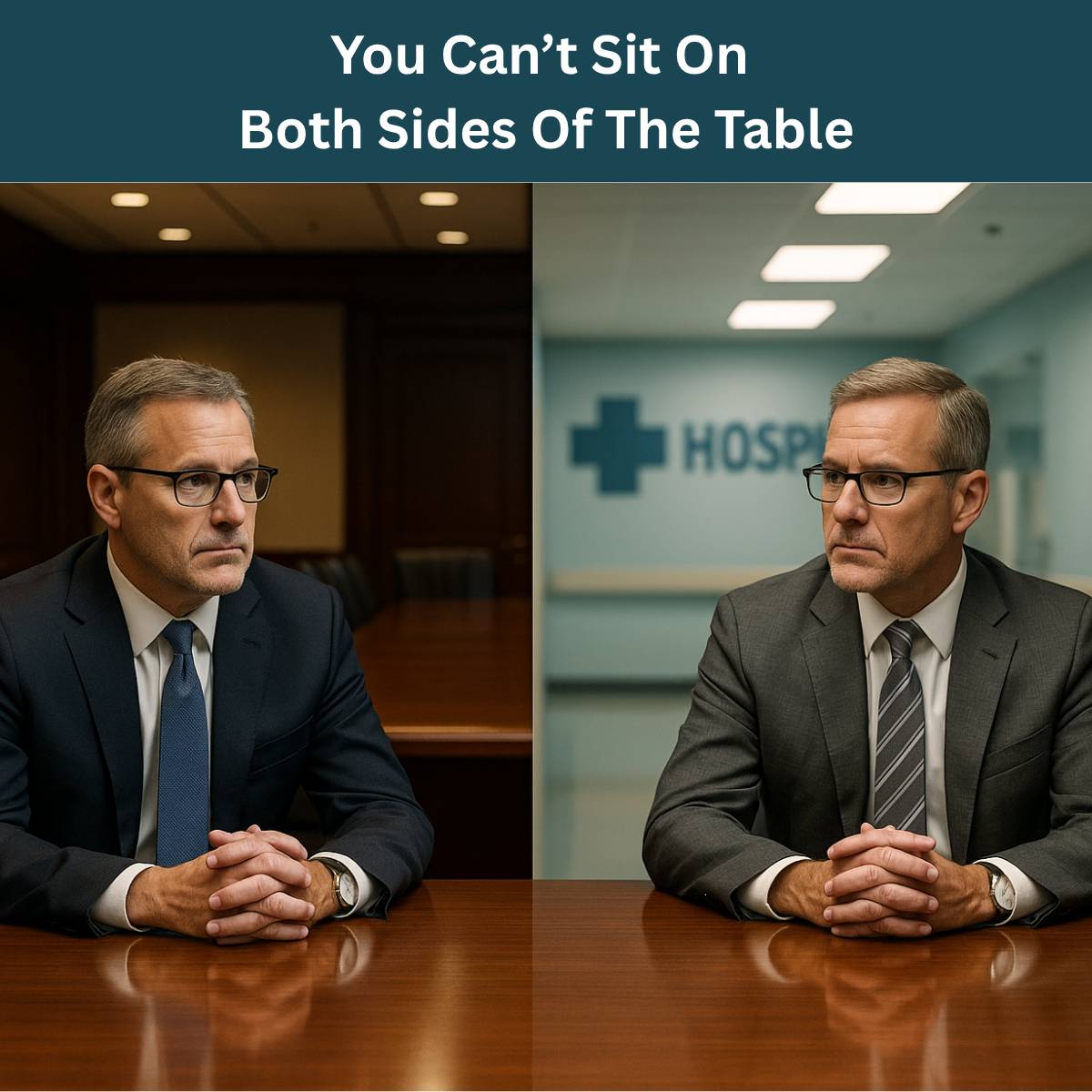
You can’t serve two masters—especially when one sends your employees to collections.
A CEO is invited to join the board of the local hospital—the same hospital that overcharges the plan, sues employees over bills, and refuses to share pricing data.
That’s not a big honor. It’s a fiduciary problem.
Fiduciary duty under ERISA requires loyalty to plan participants and their beneficiaries. Not to providers. Not to civic prestige.
This week’s dilemma: Is hospital board service a civic contribution—or a compliance conflict?
If you’re managing a health plan, the answer matters more than you think.
What Fiduciary Duty Requires
ERISA fiduciaries must act solely in the interest of plan participants. No divided loyalties. No split priorities. That includes:
Choosing vendors based on price, quality, and value—not personal relationships
Monitoring hospital and TPA behavior for conflicts, errors, and misaligned incentives
Avoiding self-dealing or even the appearance of divided loyalties
Board membership at a contracted healthcare provider introduces a tension:
Are you in a position to advocate for participants?
Or are you in a position that makes advocacy awkward or unlikely?
Sitting on both sides of the table doesn’t make you neutral. It makes you compromised.
The Real-World Dilemma
Here’s how one CEO framed the challenge in a recent LinkedIn post:
“If I am the CEO of a self-funded company and sit on the board of the local “non- profit” health system whose chargemaster is 10X Medicare, bills $250K for outpatient procedures, and chases my lower paid employees for balances, have I violated my fiduciary responsibility to my plan? Do I have an obligation to review the financial activity of that health system as to its’ impact on my plan?”
Jeff Gasser is the co-founder and CEO of Deerhold, Ltd. The comments to his post are worth reading and generally point toward “Yes” it’s a violation of his fiduciary responsibility and “Yes” he has an obligation to review the financial activity of the health system.
Overall conclusion? CEOs need to stop accepting hospital board seats.
Conflicted—or Constructive?
Could a CEO use the board seat to improve the hospital’s billing and pricing practices? Possibly.
Could the CEO advocate for participants in both roles at once? It’s not illegal.
But…
That’s not the test.
The question is:
Can you demonstrate your fiduciary decisions are free from influence—and solely in the interest of participants?
If the hospital’s billing practices harm your members, and you don’t challenge them—was it because of the board seat?
If you re-sign a hospital contract with excessive markups —can you prove you weren’t swayed?
In a courtroom, “noble intentions” don’t cut it.
You Can’t Sit On Both Sides of the Table
Solution: Realignment, Not Rationalization
There are other ways to contribute to your community without compromising your role as a fiduciary.
Share data about hospital impact on your plan—price variation, quality, satisfaction
Convene multi-stakeholder groups to discuss billing reform, transparency, and value-based design
Partner with DPC clinics, ASCs, and fair-price networks that align with fiduciary goals
Let others lead hospital governance—while you lead on fiduciary integrity
You don’t have to demonize your local hospital. But you do have to scrutinize it.
How to Respond With Integrity
If you’ve been invited to join a hospital or provider board:
Ask your legal counsel about conflict implications
Review past plan decisions involving the provider—contracts, audits, complaints
Document how you will maintain independence and prioritize participants
Consider an alternative way to contribute—one that doesn’t compromise oversight
If a current fiduciary sits on a provider board:
Discuss whether recusal, resignation, or reallocation of duties is appropriate
Ensure vendor selection, contracting, and monitoring are fully documented
ERISA fiduciaries must act solely in the interest of participants—no split loyalties
Hospital board seats can impair independent judgment and negotiating power
Community leadership is admirable—but not at the expense of fiduciary duty
Vendor “capture” is a subtle, but real threat to fiduciary duty
Declining a board seat isn’t disloyal—it may be the most loyal thing you can do
Fiduciary loyalty means protecting your people even when it’s uncomfortable.
The PBM Field Guide Is Coming
The tools to operationalize PBM reform are on the way.
RosettaFest 2025
This summer, Nautilus is launching the PBM Field Guide at RosettaFest 2025 in Denver—a practical roadmap to apply the best of state reform, align with fiduciary principles, and take back control of your pharmacy benefits.
The guide is structured around the Six Pillars of Fiduciary-Aligned PBMs:
Clinical stewardship
Full financial transparency
Unconflicted procurement
Data ownership & protection
Local access & provider fairness
Attestation & oversight
Advisers and employers will be able to:
Make confident, compliant decisions in the best interest of plan participants
Use open-source RFP language, contract terms, and transparent pricing standards
Avoid hidden fees, audit obstacles, and rebate distortions
Build oversight systems that keep vendors honest—and participants protected
Join the Brightest Minds, Leaders, and Change Makers.
Tired of the dark? Join us at RosettaFest 2025—and help build the future of pharmacy benefits. You’ll never look at PBMs the same way again.
💸 SPECIAL OFFER: Newsletter subscribers receive 10% off any Validation Institute service. Use code FIDUCIARY10 at checkout.
validationinstitute.com
📬 PAY IT FORWARD: Feel free to forward this offer to your broker, PBM, or other vendors. Don’t hesitate to tell them you will favor validated vendors as part of your modernized procurement processes. Strong compliance and better benefits begin with validation.
Don’t be a bystander. Change the status quo and reap the benefits of The Health Plan Compliance Advantage.