I spent Friday at a conference talking with PBMs. They’re still receiving RFPs for January 1 starts. Several said the same thing: to implement on time, they need a signed contract in two weeks.
That’s a tighter deadline than most plan sponsors think they’re working against, and the vendors know it better than the buyers do.
Here’s what happens when a sponsor arrives at signature with two weeks of runway. They stop negotiating. Whatever arrives on the vendor’s paper gets signed, because the alternative is a very bad conversation with leadership in December.
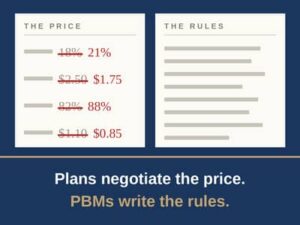
Compressed timelines move money. They move it quietly, through terms instead of rates. A sponsor with ninety days has alternatives. A sponsor with fourteen days has a deadline. The audit language stays. The termination fee stays. The definitions stay exactly as drafted. All of it is invisible in the pricing summary that goes to the committee.
The Contract X-Ray 90 Standard is the way out, and it works faster than the alternatives.
The Fastest Contract Is a Scored One
The reflex under time pressure is to skip negotiation and get to signature. That reflex is backwards.
Selecting an unscored contract commits you to open-ended redlining. Eighty pages, no map, outside counsel billing hourly against a fixed date, and a vendor who knows your date. You find out what you agreed to when the markup comes back, and you find out what you missed in the second plan year.
Selecting a pre-scored contract removes that step. You already know where the agreement stands, so the time goes to implementation instead of discovery.
If you’re facing a deadline, three doors are open to you right now.
Start with vendors whose contracts already clear 90. Ten PBMs have executed agreements at that level. If a finalist is already there, your contract phase compresses to confirming the paper in front of you matches the paper we scored. That’s days rather than weeks.
Score the one you have. If your finalist hasn’t been scored, submit the agreement now and work from a gap list. Knowing that Sections 9, 14, and 22 are where your exposure sits turns an eighty-page review into a three-clause negotiation. Your counsel spends their hours where the money is.
Extend and finish properly. Nobody in the room will offer this, because every party is paid on closing. A short extension costs a known amount. Three years under a contract scoring 42 costs an amount you can’t calculate yet.
An Extension Is a Contract, Not a Delay
That third door needs a warning label, and the reason sits in the contracts themselves.
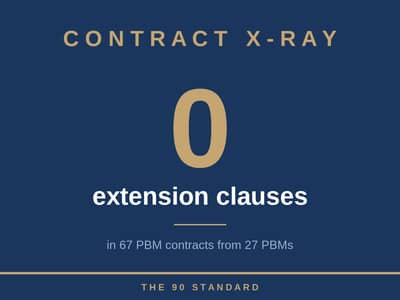
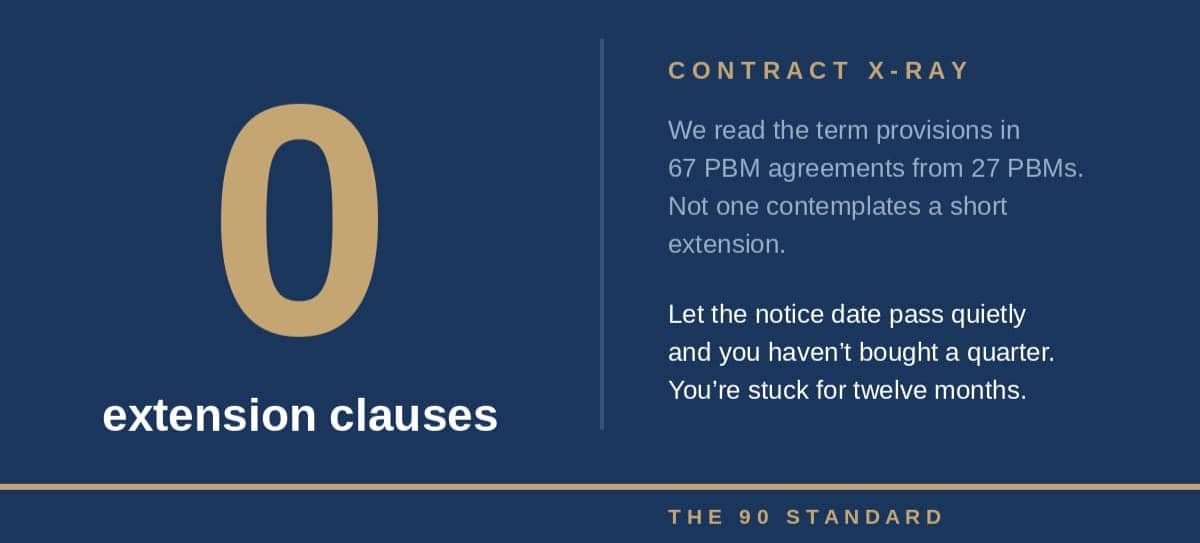
We looked at the term provisions across 67 agreements from 27 PBMs. Not one of them contemplates a three or six month extension. The architecture is the same everywhere: a fixed initial term, automatic renewal in twelve-month increments, and a notice window before the term boundary as the only scheduled decision point.
That matters more than it sounds. A commercial lease gives you a month-to-month holdover. These agreements give you a year. Let the date pass quietly and you haven’t bought a quarter. You’re stuck for twelve months.
So the extension has to be drafted and signed by both parties, and here is where the money hides. Most of these contracts calibrate financial guarantees to full contract years and switch them off for a partial one.
One agreement states the guarantees will not apply for a Partial Contract Year. Another provides the PBM has no obligation under any financial guarantee for a contract year in which the sponsor terminates before twelve full months elapse.
Sign a ninety-day extension on the vendor’s one-paragraph letter and you may run that quarter with your pricing and rebate guarantees switched off. Members keep filling prescriptions the whole time.
Four provisions separate a clean bridge from an expensive one.
Guarantees prorate. The extension period is measured proportionally and rolls into the annual reconciliation, rather than sitting outside it as a Partial Contract Year.
Earned rebates survive. Rebates on claims incurred during the extension get paid in full on the standard schedule, free of offset or forfeiture at the stub end.
The clock holds. The extension continues the existing term rather than starting a new Initial Term, and it leaves your implementation credit and amortization schedules exactly where they are.
It expires on a date. State the end date and confirm the extension carries a single term with no renewal of its own.
Your incumbent’s willingness to sign depends on whether they think they can win the re-bid. That’s worth knowing before you ask. Ask ninety days before your notice window and the conversation is a business discussion. Ask thirty days after it and you’re asking a favor.
Then weigh the cost against what it buys. A bridge that surrenders a quarter of guarantees to reach a contract scoring 90 is still the cheapest thing on the table, because the quarter ends and the contract runs three years.
Not One Contemplates An Extension
Something for Everybody
If you’re an advisor with a client running late. You have the highest-leverage move available to anyone in this process. Tell your client what the clock is doing to their terms, and give them the three doors above. Ask each finalist one question: has your standard agreement been scored, and what did it score? Then have the four-provision extension amendment drafted before a client needs it. An advisor who can put a clean bridge in front of a client in 48 hours is doing something a broker cannot, and the record that you raised it matters more than most advisors realize.
If you’re a plan sponsor. Your leverage ends when you name a finalist, not when you sign. The 90 Standard has to be in the room before selection. Say it out loud in the finals presentation and put it in the award letter. If you’re already past selection, apply it anyway, because a vendor in implementation still wants a clean start and a reference. And if the calendar has genuinely run out, extend. Bring your own paper, because the contract you have almost certainly lacks an extension clause.
If you’re a PBM. A standard agreement that already clears 90 is a closing advantage this month. It shortens your contract phase, it removes the redline cycle that puts your January 1 dates at risk, and it answers the fiduciary question a benefits committee is now being told to ask. Ten of your competitors can already say it. If you want to know where your paper stands before the next RFP arrives, the methodology is published and the scoring is confidential.
What to Do First Thing Monday
Count your actual days. Work backward from January 1. Sixty days of implementation puts signature at the end of October, and that is the outer limit rather than the target. Your vendors are asking for signatures inside two weeks because they want the margin. Plan against their number, not yours.
Ask the one question. Send it to every finalist today: has your standard agreement been scored against The 90 Standard, and what did it score? The answer tells you something either way.
Get a gap list, not an opinion. Submit your finalist’s agreement for scoring at contractxray.com. Direct your counsel at the provisions that matter instead of the whole document.
Set your extension trigger. Pick the date at which you’d rather extend than sign blind, and tell your committee what it is before you reach it.
Draft the amendment now. Have the four-provision extension amendment sitting ready. Drafting it under pressure, on the vendor’s paper, is how the guarantees go missing.
In Closing
Every incentive in this process points toward closing. The broker, the vendor, and the calendar all want a signature. The only party who benefits from slowing down is the plan, and the only person in the room who represents the plan is you.
A contract signed in a hurry is still a contract for three years.
You choose who you do business with. You choose the terms. Nothing under 90.
Here’s to clearer thinking, stronger plans, and better outcomes for the people who rely on us.
All the best,
P.S. Next week we write to the advisors and consultants who run these procurements. If that’s you, your work product is discoverable, and there’s one line that documents you set a bar.
────────────────────────────────────────
A Note of Appreciation
Jon Rankin
Jon Rankin is President and CEO of the North Carolina Business Coalition on Health (NCBCH). For the last 10 years he has been a trusted expert, adviser, educator and innovator for employer healthcare and benefits to organizations across North Carolina.
Subscribe & Share
🔗 Subscribe: Was this newsletter forwarded to you? Signup to receive The Middleman’s Cut every Monday.
📤 Share: Know someone reviewing a PBM contract? Forward this issue.
Tools and Resources
Take The First Steps
Mark Cuban inspired me to write The Middleman’s Cut. The book draws on his public comments, used with his permission. The Foreword is particularly compelling building the case for change. I’m including a free version for readers of this newsletter to download.
Employers pay far more than they should to middlemen most executives have never heard of. Change the status quo and reap the benefits. Employers who act are recovering 20% to 30% of pharmacy spend, and returning it to wages and benefits. Schedule an introductory call with us.