Pull your PBM contract. Find the audit rights section. Read it carefully.
Here’s what you almost certainly will notice: the language looks reasonable. It mentions audits. It references procedures. It allows for inspection. Nothing jumps off the page.
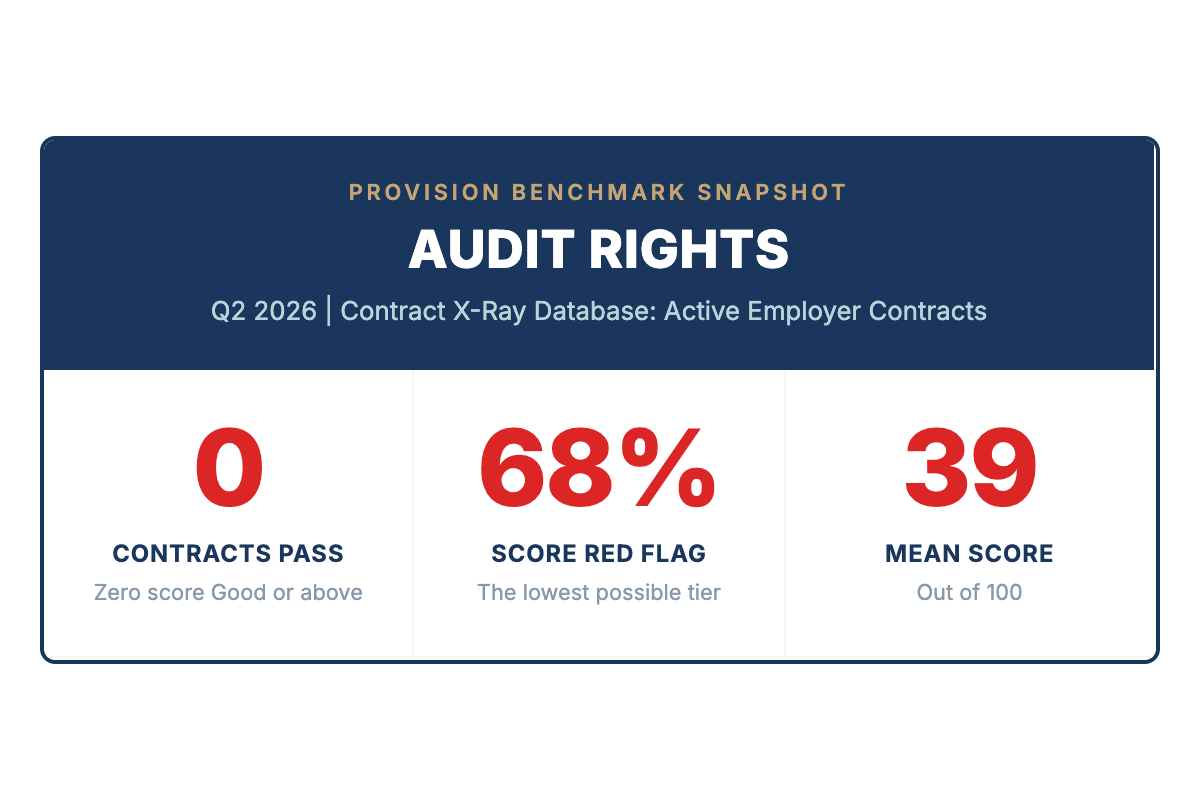
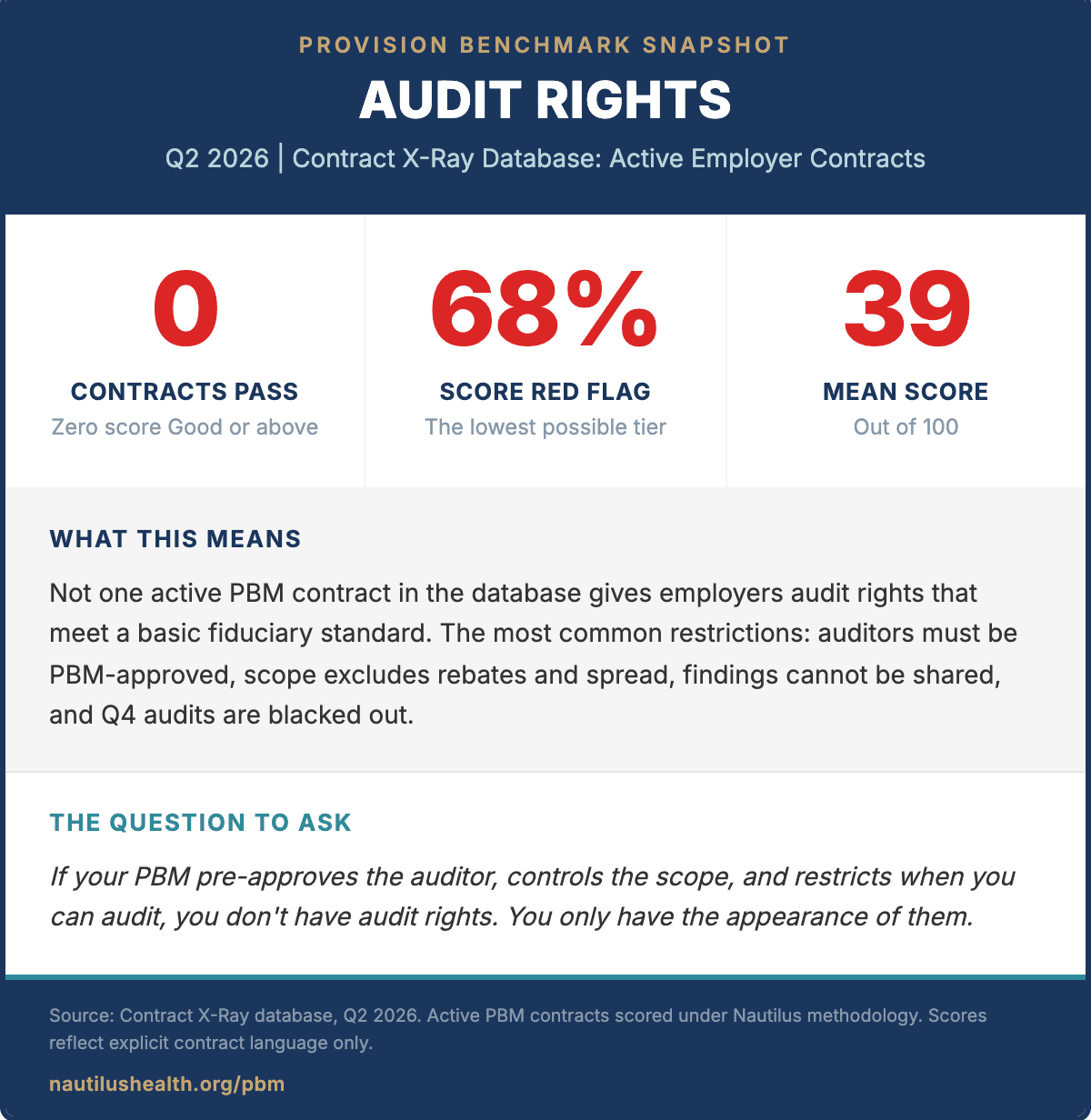
Now consider this. Across 30 active PBM contracts in the Contract X-Ray database not one scores Good or above on audit rights. Not one. Not templates, not proposals, but negotiated agreements currently governing employer health plans. 68 percent fall into the Red Flag tier, the lowest band on the scale. The mean score is 39 out of 100.
The point isn’t that your contract is unusually bad. The point is the language in your contract may seem normal until you see how pervasive the problem is across every contract in the market.
Audit Rights
Why Your Contract Looks Normal
An employer reading their own audit clause sees boilerplate. Only by looking across a body of contracts do you discover that “normal” is the problem.
This is what Contract X-Ray makes visible. Not just by identifying outliers, but by showing the entire market has converged on language protecting the PBM’s information advantage while appearing to grant oversight.
Four Restrictions That Almost Certainly Apply to You
Across the database of active employer contracts, four restrictions appear with striking consistency:
1. The PBM pre-approves your auditor. You can audit but only with a firm the PBM blesses. The firms that survive this filter are the ones the PBM has worked with comfortably before.
2. Audit scope is restricted to specific claim categories. Rebates, network spread, and manufacturer revenue are commonly carved out of what an auditor is permitted to examine. The categories most likely to contain recoverable dollars are the categories least likely to be auditable.
3. Findings cannot be shared with third parties. In one publicly available coalition agreement, the contract states audit findings “shall not be revealed in any manner or form” including to the employer itself. Read that again. The employer commissioning and paying for an audit is contractually prohibited from reading or sharing it.
4. Audit windows are restrictive. You can audit but only in narrow time windows with limited lookback rights.
Each restriction, on its own, sounds somewhat reasonable. Grounded operationally. But together, they describe a system in which audit rights exist on paper and almost nowhere else.
Why Audit Rights Are the Meta-Provision
Pharmacy contracts contain many problems: spread pricing, rebate retention, carve-out penalties, termination traps. Most of these are visible to an employer who reads the contract carefully or works with a knowledgeable advisor.
Audit rights are different. They’re the meta-provision, the one that determines whether you can verify everything else.
If your audit rights are broken, every other commitment in the contract becomes unenforceable in practice. The PBM can promise pass-through pricing and 100% rebate flow-through, and you have no usable mechanism to confirm either one.
A 39 mean score on audit rights isn’t just a technical finding. It’s the reason every other number in the contract is harder to trust than it should be.
What Benchmark Data Changes
Without benchmark data, every employer arrives at the negotiating table assuming their audit clause is standard. The PBM agrees, because it largely has been. Both sides treat the language as immovable. The negotiation moves on to pricing.
With benchmark data, the conversation changes. The active contracts in the database, the ones scoring 39 on average, with 68% in Red Flag territory, represent what employers signed in the past.
But that’s not the whole picture.
Some PBMs are now introducing “CAA 2026 Ready” contracts with audit provisions that score Excellent. These aren’t negotiated exceptions. They’re standard terms, offered to employers who know to ask for them.
You should expect the same from your PBM.
Language That Moves The Market
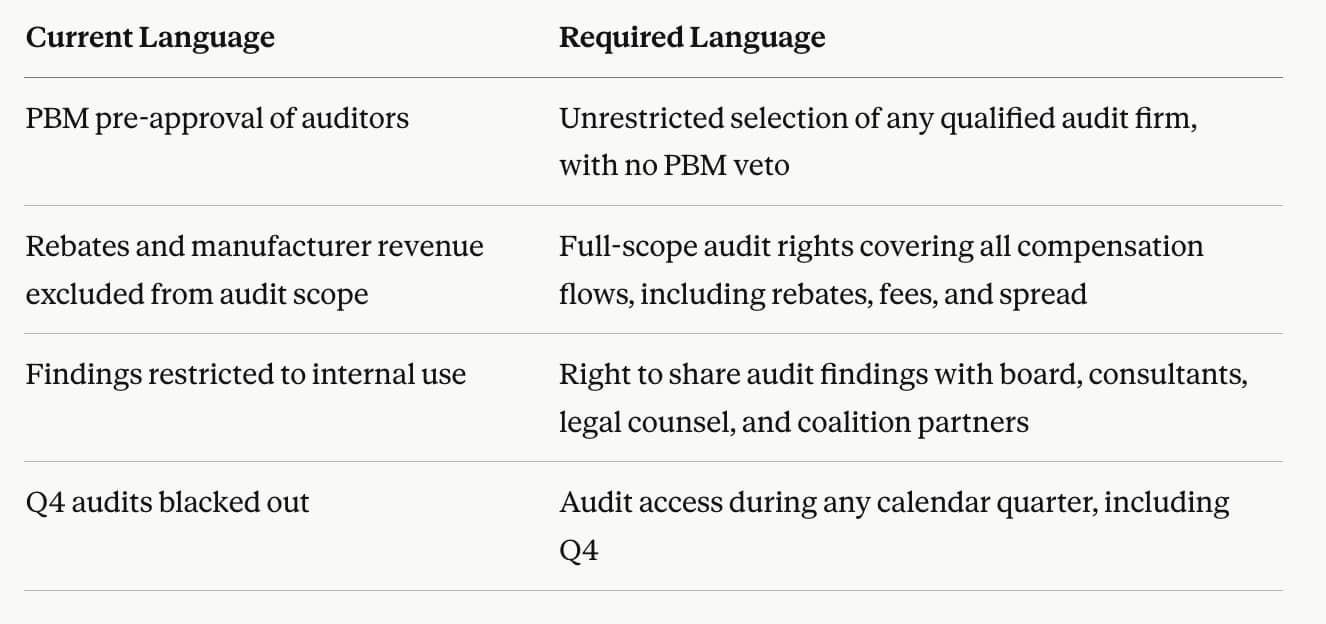
When your PBM says the audit language is “standard”, here’s how to respond:
Current Language vs.. Required Language
What to Do First Thing Monday
Pull the audit rights section of your PBM contract and read it, not for what it allows, but for what it restricts.
Ask your benefits attorney three questions: Does our contract require PBM pre-approval of any audit firm we engage? What categories of spend are excluded from audit scope? Can we share audit findings with our coalition, advisors, or board?
Compare to the benchmark. If your contract contains all four restrictions, you’re in the 68% that score Red Flag. That’s not unusual, it’s the current market. But it’s not acceptable.
Submit your contract for scoring and negotiation talking points Email support@nautilushealth.org. The benchmark grows one contract at a time and so does employer leverage.
In Closing
The contract is a document about trust. Audit rights are the section that determines whether trust has to be taken on faith. It doesn’t.
Zero out of thirty means you must verify.
The benchmark exists so employers don’t have to guess and so PBMs can’t claim that restrictive language is the only option. As more employers demand the model language, PBMs will adopt it as standard. Some already have. Others will follow. Collective action and eliminating information asymmetry moves markets.
Here’s to clearer thinking, stronger plans, and better outcomes for the people who rely on us.
All the best,
P.S. Next week: You’ve found the audit restrictions. Now what? How to negotiate audit rights that actually work, and what to do when the PBM says no.
Subscribe & Share
🔗 Subscribe: Was this newsletter forwarded to you? Signup to receive The Health Plan Compliance Advantage every Monday.
📤 Share: Know someone negotiating a PBM contract? Forward this issue. The three attorney questions alone could change the conversation.
💸 SPECIAL OFFER: Newsletter subscribers receive 10% off any Validation Institute service. Use code FIDUCIARY10 at checkout.
────────────────────────────────────────
Don’t be a bystander. Change the status quo and reap the benefits of The Health Plan Compliance Advantage. Schedule an introductory call with us.