Your specialty pharmacy spend is up 30% year over year. An advisor walks you through a program that could cut several hundred thousand dollars off your specialty drug costs in the first year. The clinical model is sound. The savings are real. The references check out. You want to move forward.
Now pull your PBM contract. Find the section on exclusivity and vendor rights. Read it carefully.
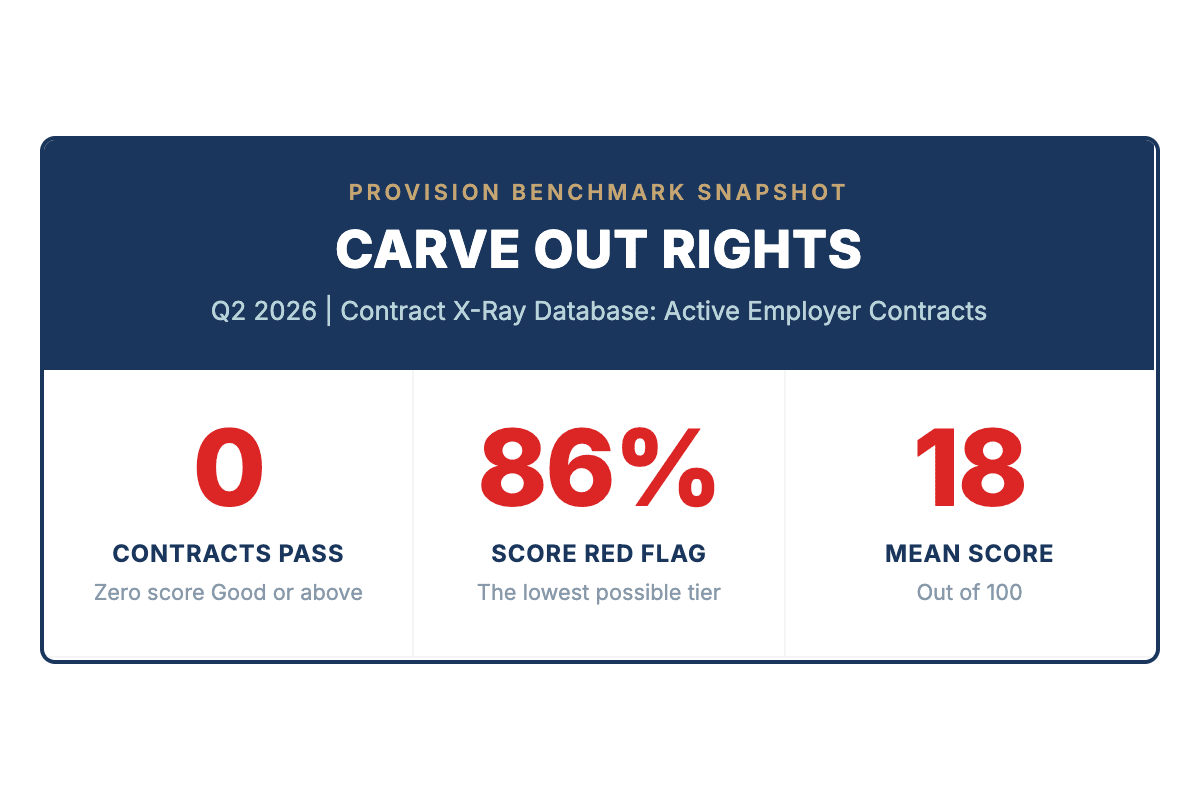
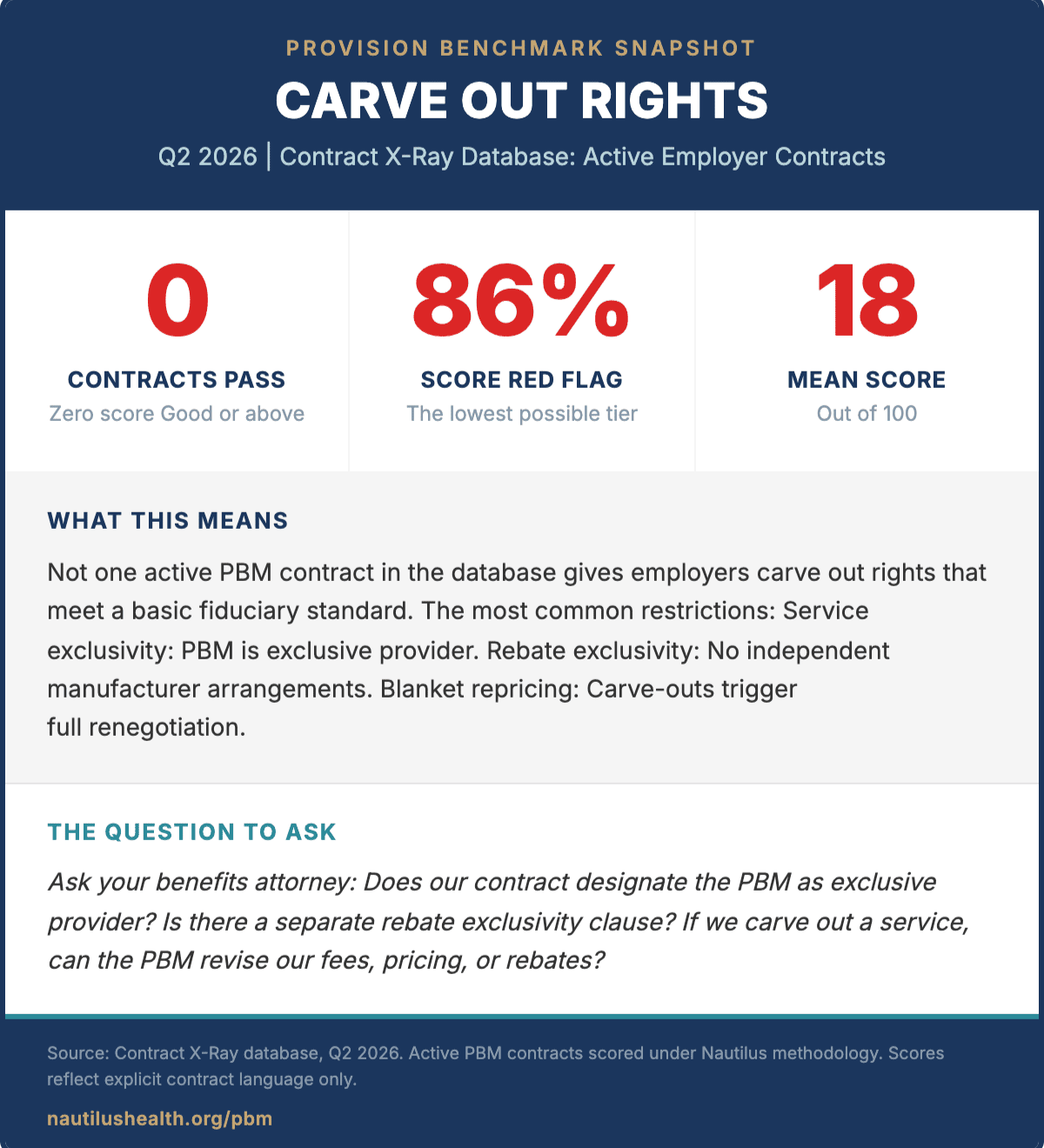
In 86% of the active contracts in the Contract X-Ray database, the answer to “can we do this?” is somewhere between “no” and “not without a fight.” The mean score across the database is 18 out of 100, the lowest of any provision we evaluate. Lower than audit rights. Lower than every other category in the framework.
The provision has a name: Carve-Out and Independent Vendor Rights. It determines whether your contract permits you to act on a better deal when you find one. Across the market, the answer is almost always no.
Carve Out Rights
The Three Patterns That Lock You In
Across the database of active employer contracts, three restriction patterns appear repeatedly:
Pattern 1: Service Exclusivity. “Participating Group shall make [PBM] the exclusive provider of the Services described in this Agreement.”
This is from a publicly available coalition contract. The plan sponsor cannot engage an outside vendor for any service the PBM provides regardless of price, performance, or fit. A specialty carve-out, an alternative program, a clinical management vendor: each one becomes a contract violation.
Pattern 2: Rebate Exclusivity. A separate clause in the same contract: “[PBM] shall have the exclusive right to pursue rebates on drugs dispensed to Plan Participants. Participating Group covenants and agrees that neither Participating Group nor any Plan will directly or indirectly negotiate, contract, or agree with any pharmaceutical company, or any other third party, for the purpose of obtaining rebates or discounts.” This is a second exclusivity layer. It prohibits independent manufacturer arrangements, alternative funding participation, and rebate aggregator engagement. Service exclusivity locks the front door. Rebate exclusivity locks the back door.
Pattern 3: Blanket Repricing. A different contract takes a softer approach. The PBM doesn’t prohibit carve-outs outright. Instead: “If any pharmacy benefit service is carved out, the fees quoted above may be revised.” Translation: the moment you exercise any vendor flexibility, every other financial term in the contract is up for renegotiation. The economic cost of using outside vendors is engineered to exceed the savings.
Most contracts use one of these three approaches. A smaller number are silent on carve-out rights which sounds neutral but functions as silent restriction. Without an express right to carve out, the plan sponsor acts on implied permission the PBM can challenge at any time.
The Fiduciary Contradiction
One contract in the database is particularly clear. The PBM commits in writing to recommend international sourcing and member financial assistance programs as part of its fiduciary functions then prohibits the employer from engaging any outside vendor to deliver those exact programs.
The fiduciary commitment and the exclusivity clause sit two pages apart.
This is the contradiction that surfaces repeatedly. PBMs that present themselves as fiduciary partners include exclusivity clauses that prevent employers from acting on better options the PBM cannot match.
Why Carve-Out Rights Are the Agency Provision
Last week we covered audit rights, the provision that determines whether you can verify what your PBM is doing. Carve-out rights are the companion provision. They determine whether you can act on what you find.
A weak audit clause means you can’t verify. A weak carve-out clause means you can’t act. The first failure is information. The second is agency.
Plan fiduciaries have a duty to evaluate the cost and quality of plan services on an ongoing basis. CAA 2026 reinforces this duty with explicit fee-disclosure requirements and a heightened standard of prudence. Carve-out rights are the contractual mechanism that allows fiduciaries to act on that evaluation.
Without them, the duty exists. The means to discharge it do not.
An 18 mean score on carve-out rights isn’t just a technical finding. It’s the reason employers can’t act on opportunities they’ve already identified.
What Benchmark Data Changes
Without benchmark data, every employer assumes their exclusivity language is standard. The PBM agrees, because it largely has been. Both sides treat the clause as immovable. The conversation moves on to pricing.
With benchmark data, the conversation changes.
The active contracts in the database, the ones scoring 18 on average, with 86% in Red Flag territory, represent what employers signed in the past. But that’s not the whole picture.
Some PBMs are now introducing “CAA 2026 Ready” contracts with carve-out provisions that score Excellent. These aren’t negotiated exceptions. They’re standard terms, offered to employers who know to ask for them.
You should expect the same from your PBM.
Language That Moves The Market
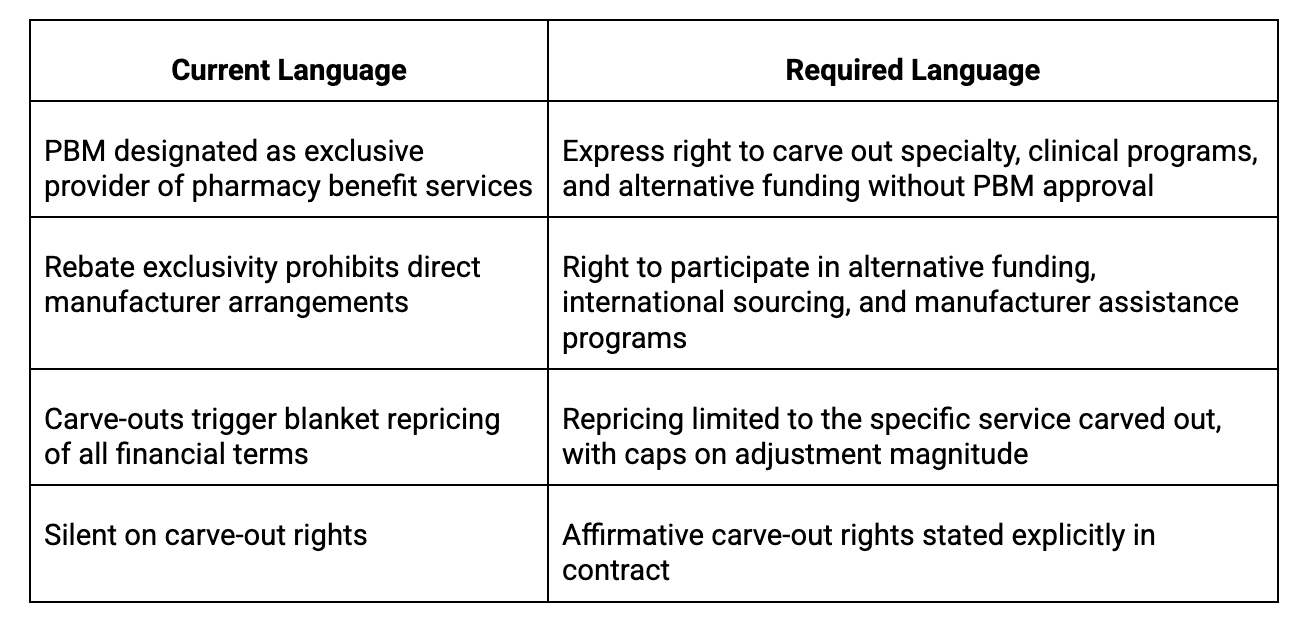
When your PBM says the exclusivity language is standard, here’s how to respond:
Language That Moves The Market
What to Do First Thing Monday
Pull the exclusivity section of your PBM contract and identify which pattern applies: service exclusivity, rebate exclusivity, blanket repricing, or silence.
Ask your benefits attorney three questions: Does our contract designate the PBM as exclusive provider? Is there a separate rebate exclusivity clause? If we carve out any service, can the PBM revise fees, pricing, or rebate guarantees?
Compare to the benchmark. If your contract contains any of the three restriction patterns, you’re in the 86% that score Red Flag. That’s not unusual, it’s the current market. But it’s not acceptable.
Submit your contract for scoring. Email support@nautilushealth.org. The benchmark grows one contract at a time, and so does employer leverage.
In Closing
A contract should permit you to do your job. The carve-out provision is the section that determines whether you can.
Eighteen out of one hundred says, in most contracts, you cannot.
But CAA 2026 Ready contracts exist. Some PBMs are already offering carve-out language that scores Excellent as standard terms, not negotiated exceptions. Employers who know to ask are getting them.
The benchmark exists so you know what to ask for. And so PBMs can’t claim restrictive language is the only option.
Here’s to clearer thinking, stronger plans, and better outcomes for the people who rely on us.
All the best,
P.S. Next week: The language that fixes both problems. How to negotiate audit and carve-out rights that actually work.
Subscribe & Share
🔗 Subscribe: Was this newsletter forwarded to you? Signup to receive The Health Plan Compliance Advantage every Monday.
📤 Share: Know someone negotiating a PBM contract? Forward this issue. The three attorney questions alone could change the conversation.
💸 SPECIAL OFFER: Newsletter subscribers receive 10% off any Validation Institute service. Use code FIDUCIARY10 at checkout.
────────────────────────────────────────
Don’t be a bystander. Change the status quo and reap the benefits of The Health Plan Compliance Advantage. Schedule an introductory call with us.