Most employers signed whatever contract was put in front of them.
They don’t know what good looks like because no one ever gave them a benchmark. PBMs don’t make comparisons easy.
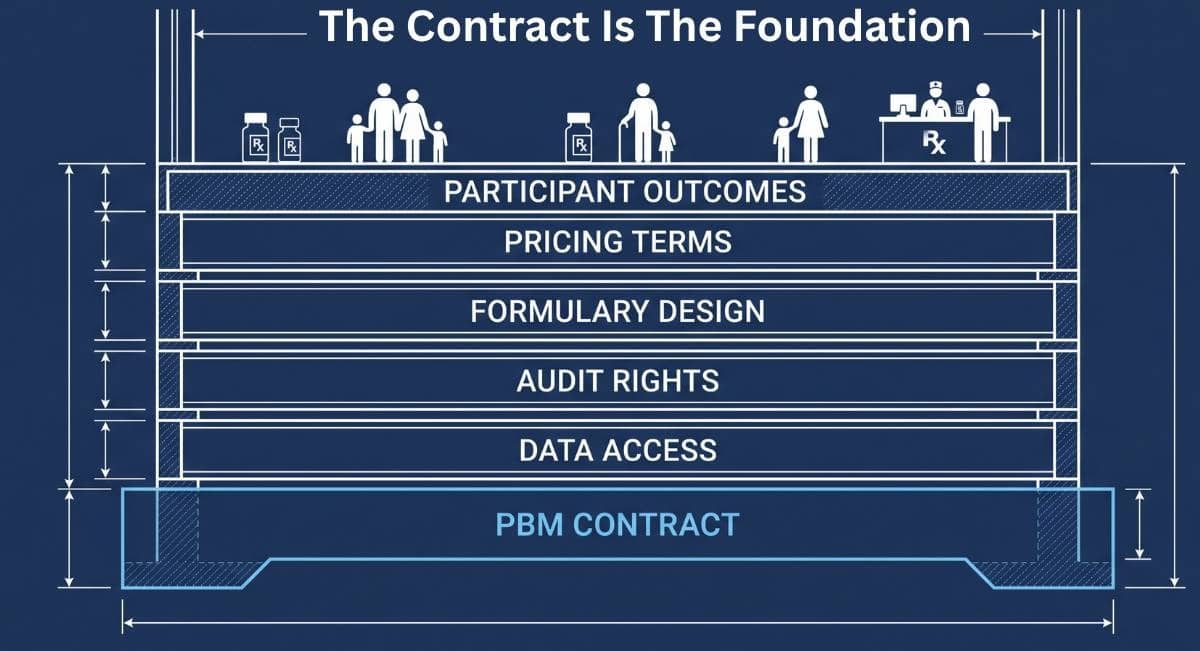
The PBM contract is the foundation your benefits stand on. What it allows, your plan can do. What it forbids, your people live with. Everything downstream, whether costs, formulary, or friction at the pharmacy counter, sits on top of that document.
The new EBSA administrator, has signaled new enforcement priorities will focus on “direct evidence of disloyalty” to plan participants and “impermissible conflicts of interest.”
– Daniel Aronowitz, Assistant Secretary, Employee Benefits Security Administration, United States Department of Labor
A contract that constrains your ability to act in participants’ best interest isn’t just a procurement gap. It’s the documentation EBSA says it’s looking for.
The Contract Is The Foundation
Conflicts and Disloyalty
This is a distinction that matters. Conflicts create the incentive. Disloyalty is acting on it or letting it happen.
Conflicts of interest are structural. A PBM that owns pharmacies has a conflict. A PBM that receives manufacturer payments tied to volume has a conflict. A PBM with a spread pricing model has a conflict.
These relationships create competing incentives with the obligations of plan sponsors. They’re not necessarily wrong by themselves, but they require disclosure by PBMs and management by fiduciaries.
Disloyalty is what happens next. It can be active or passive. Signing a contract you didn’t read. Accepting terms that constrain your ability to act. Not asking for disclosure you’re entitled to receive. Failing to audit when you have the right.
Here are some real world examples of conflicts and disloyalty to avoid:
A PBM that owns pharmacies has a conflict of interest. A fiduciary who lets the PBM steer members to those pharmacies and charge higher prices is disloyal.
A PBM with a spread pricing model has a conflict of interest. A fiduciary who signs a contract without audit rights is disloyal.
A PBM receiving manufacturer payments tied to volume or market share has a conflict of interest. A fiduciary who accepts a formulary driven by rebates instead of clinical value is disloyal.
The contract documents which one you chose.
From Compliance to Outcomes
The value of understanding your contract builds in stages. Each of these 6 stage produces something real.
See what you have. Scoring your contract against fiduciary-aligned contract standards answers the question every employer should be able to answer: where do we stand? Does your contract penalize you for lowering drug costs? Does it allow you to access your data and audit your findings?
Know your exposure. A documented review is itself a fiduciary defense. Prudence leaves a paper trail. Negligence does too, just the wrong kind. An audit clause that prohibits your choice of auditor is a conflict. A fiduciary who signed it without objection let it happen.
Negotiate with real leverage. Stop signing what the PBM wrote. Lead your procurement with a contract. Set an expectation PBMs will sign up for fiduciary-aligned model language. Fiduciary alignment isn’t aspirational when you select PBMs who will agree to it.
Pivot from compliance to outcomes. Once the contract allows it, benefits design can be optimized for participant health rather than extraction math. A formulary driven by manufacturer rebate arrangements is a conflict. A formulary driven by lowest net cost is loyalty.
Run the plan proactively with data. Data ownership and audit rights unlock benchmarking, fee reasonableness review, and recovery. A contract that classifies your claims data as “PBM Confidential Information” is a conflict. Full access to data and unrestricted audit rights is loyalty.
Collective action with peers. Shared leverage attracts aligned partners. One employer is a data point. Collective action moves markets. When employers compare contract terms, the provisions that look “standard” reveal themselves as conflicts the market has already solved elsewhere. Schools with schools, cities with cities. Learn what good looks like and then contract for it.
What This Means at the Pharmacy Counter
Everything above is abstract until it shows up in someone’s life. So here’s the translation.
Right drug, right participant, right cost. When the formulary aligns with clinical need rather than rebate value, your people get the medicine they need.
Less friction. Fewer cases of high list prices and high deductibles driving your employees to make hard choices like skipping doses or refills.
Lower out-of-pocket. When the contract separates clinical decisions from financial ones, copays stop reflecting the PBM’s rebate math.
This is what fiduciary alignment actually buys. Not just a better contract or spreadsheet. A better morning at the pharmacy.
It Doesn’t Have to Be This Hard
The PBM has the conflict. The fiduciary owns the loyalty.
But it doesn’t have to be this hard. Some PBMs will contractually commit to fiduciary alignment. No conflicts. No pharmacy ownership. No steering. No spread. No hidden retention or markups. A written obligation to put participant interests first.
The challenge is sorting the marketing claims from the real commitments. That’s what Contract X-Ray does. Score the contract. See what’s actually in writing. Then decide.
Find a PBM willing to sign fiduciary-aligned terms and the disloyalty question fades. The conflict management burden drops. You stop playing defense and start focusing on the first principle:
Right drug > Right participant > Right cost.
What to Do on Monday
1. Pull your current contract. All amendments. All exhibits. If your team can’t find the complete document set, you’ve already identified a fiduciary issue worth fixing.
2. Read the data ownership and audit rights provisions first. These are the two you can’t recover later. You can renegotiate pricing, rebates, formulary terms. Losing data access and audit rights at signing likely locks in opacity for the life of the relationship.
3. Score it. Submit your contract for a Contract X-Ray analysis to support@nautilushealth.org. You’ll receive a category-level rating that shows where you stand against fiduciary-aligned standards and where the conflicts and loyalty gaps live.
4. Ask your advisor for their last independent review of these provisions. Not their opinion. A written review. If they can’t produce one, you know what conversation to have next.
Why This Scales
One scored contract is a data point. A hundred is a benchmark. A thousand is a market.
When enough employers score their contracts and share model language, PBMs start competing on contract quality. The market itself shifts. This is how participant-first outcomes win at scale, not one employer at a time.
Nautilus exists for this reason. Not to consult. To build the standard.
In Closing
Your contract is the foundation. Your benefits stand on it. What they stand on matters.
The PBM has the conflict. The fiduciary owns the loyalty. The contract documents which one you chose.
Score your current PBM contract this month. Share this issue with one peer whose plan you respect. That’s how the coalition grows.
Here’s to clearer thinking, stronger plans, and better outcomes for the people who rely on us.
All the best,
P.S. Next week: what employers are learning when they pool contract data. You can’t negotiate what you can’t compare. We’ll show you why PBMs resist transparency when employers act together, and what happens when they do it anyway.
Subscribe & Share
🔗 Subscribe: Was this newsletter forwarded to you? Signup to receive The Health Plan Compliance Advantage every Monday.
📤 Share: Forward this issue to your General Counsel, CFO, outside ERISA counsel, or a peer. Create alignment and collective action.
💸 SPECIAL OFFER: Newsletter subscribers receive 10% off any Validation Institute service. Use code FIDUCIARY10 at checkout.
────────────────────────────────────────
A Note of Appreciation
Daniel Aronowitz
Daniel Aronowitz is the Assistant Secretary, Employee Benefits Security Administration, United States Department of Labor. In recent testimony to a House subcommittee he explained ERISA is “a law of process” and if a fiduciary follows the process “objectively, thoroughly, and analytically” then it should be “presumed innocent.”
Don’t be a bystander. Change the status quo and reap the benefits of The Health Plan Compliance Advantage. Schedule an introductory call with us.