Why “Pass-Through” and “Rebates” Require Definitions, Not Assumptions
Executive Brief
Two terms appear in nearly every PBM contract: pass-through pricing and rebates.
Most employers believe they understand what both terms mean. Pass-through means the client pays what the pharmacy is reimbursed. Rebates means manufacturer payments returned to the plan.
Both terms are entirely contract-defined. Their meaning is whatever the contract says they mean.
Across more than 40 contracts in the Contract X-Ray database:
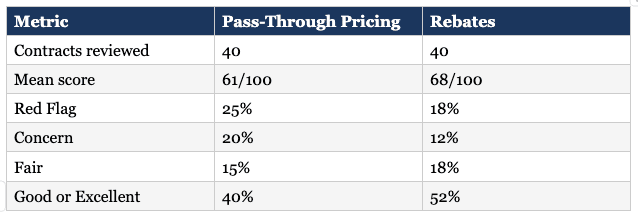
Pass-through pricing: 40% score Good or Excellent. 25% score Red Flag. Mean score 61/100.
Rebates: 52% score Good or Excellent. 18% score Red Flag. Mean score 68/100.
These are the two best-performing provisions in the database. They are also the two provisions with the most market visibility, the most negotiation attention, and the longest history of regulatory scrutiny.
And still: 45% of contracts fail the pass-through definitional test. 30% fail the comprehensive-rebate-definition test.
The reason is simple. There is no industry definition of “pass-through pricing.” There is no industry definition of “rebates.” Each contract defines its own terms. The legal effect is whatever the contract says it is.
Pass-Through Pricing: The Equivalence Test
The phrase “pass-through pricing” appears in most contracts. The language sounds protective. The contracts that fail this provision often use the phrase as prominently as the contracts that pass.
The test that separates the two is not the presence of the term. It is whether the contract commits to a single equivalence: the amount the PBM bills the client equals the amount the PBM pays to the pharmacy.
A clean pass-through provision states the equivalence explicitly. The client pays the same amount the pharmacy is reimbursed. There is no spread. The contract prohibits, by name, the mechanisms that create spread after the fact: differential charging, DIR fees, post-adjudication clawbacks, retroactive adjustments.
Two recurring failures appear in the database:
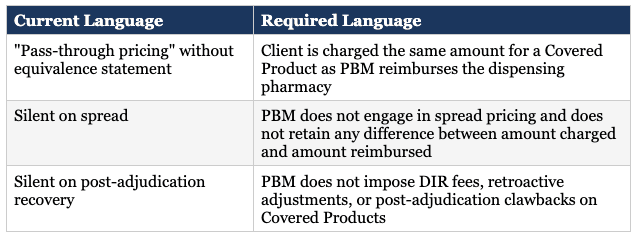
Failure: Unquantified pass-through. The contract uses the phrase “pass-through” without committing to equivalence. There is a pricing methodology. There is an AWP discount schedule. There is no contractual commitment that the amount invoiced equals the amount paid. The PBM can argue, with legal support, that partial pass-through is compliant. A federal OIG audit of a federal employee plan established that exact reading.
Faikure: Pass-through without the second prohibition. The contract commits to equivalence at the point of adjudication but is silent on what happens after. DIR fees, manufacturer chargebacks, and retroactive adjustments can recover for the PBM what the equivalence commitment prevented at the front end. The plan sees a pass-through invoice. The PBM sees a margin. Both can be true.
What fiduciary-grade language requires:
Required Language: Pass-through
Pass-through pricing is three sentences when it is done correctly. One sentence describing the equivalence. One sentence describing the spread prohibition. One sentence closing the post-adjudication door.
Rebates: The Comprehensive-Definition Test
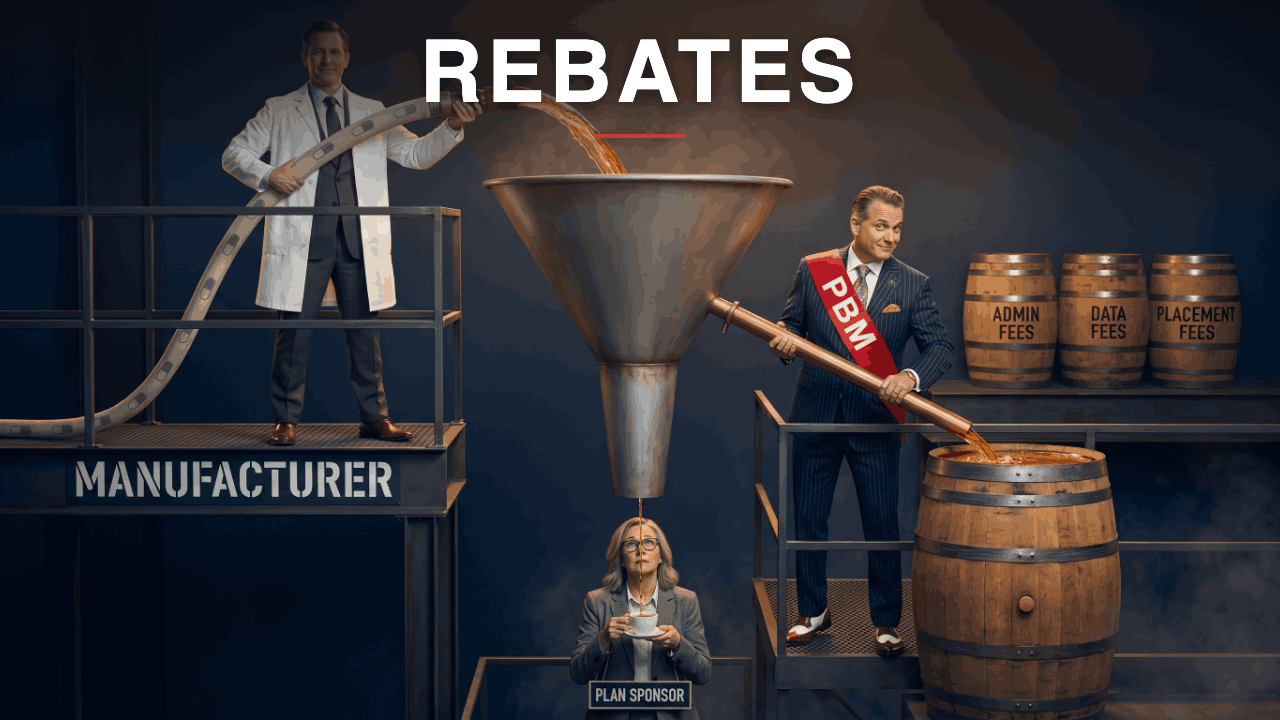
The word “rebate” is not a regulated term. The PBM industry uses it to describe the largest, most visible, easiest-to-name slice of manufacturer revenue. A contract that commits to passing through 100 percent of rebates is committing to passing through 100 percent of whatever the contract defines as a rebate.
Manufacturer revenue arrives at a PBM through many channels. Volume-based rebates are one. Administrative fees from manufacturers are another. Data fees, placement fees, formulary fees, manufacturer-funded co-pay assistance retention, GPO administrative fees, performance fees, and pricing concessions are others. The combined non-rebate revenue can equal or exceed the rebate stream itself.
Three recurring failures appear in the database:
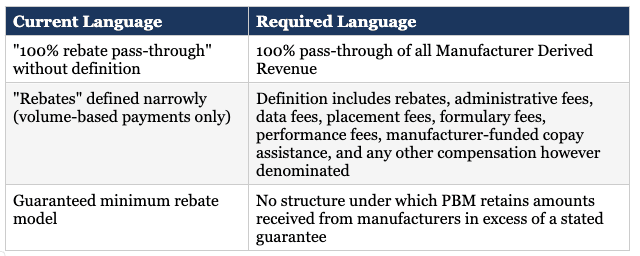
Failure: Pass-through without the percentage. The contract uses the word “pass-through” without saying 100 percent. Any percentage that is not stated is a percentage the PBM can argue. Unquantified pass-through carries the same legal exploitability as unquantified pricing.
Failure: Comprehensive language, narrow definition. The contract commits to 100 percent pass-through of manufacturer revenue, then defines manufacturer revenue narrowly enough to exclude admin fees, data fees, or placement fees. The disclosure looks complete. The math is not.
Failure: Guaranteed minimum model. The contract commits to a minimum rebate guarantee per script or per category. Any rebate received above the guarantee stays with the PBM. The plan receives a floor and forfeits the ceiling. This is the most common failure pattern by dollar volume.
What fiduciary-grade language requires:
Required Language: Rebates
Two sentences. One sentence committing to 100 percent. One sentence defining the universe the 100 percent applies to. Both are required. Neither alone is sufficient.
What the Database Shows
Provision Scoring: Pass-through Pricing and Rebates
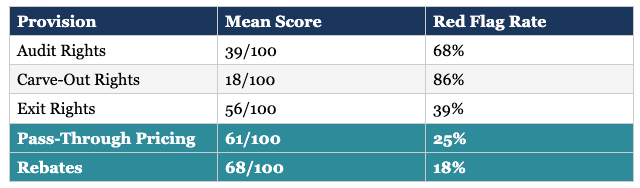
Compare these metrics to what we showed over the past month:
Comparison of Provision Scoring
Pass-through and rebates score highest because they receive the most attention. PBMs have marketed “pass-through pricing” for fifteen years. The “100 percent rebate” commitment has been a standard claim almost as long.
And still, almost half of contracts fail one or both definitional tests.
Why This Matters
Two thirds of the financial value of a PBM relationship runs through these two definitions. Pharmacy reimbursement is the first stream. Manufacturer revenue is the second.
If pass-through pricing is defined loosely, the spread that should not exist exists. The plan pays more than the pharmacy receives. The difference is invisible on the invoice and difficult to reconstruct in audit.
If rebates is defined narrowly, the manufacturer revenue that should reach the plan does not. The non-rebate categories stay with the PBM. The plan receives 100 percent of a number that is smaller than the number the plan thought it was receiving 100 percent of.
In both cases the contract appears to honor the commitment. The dollars do not.
ERISA Section 408(b)(2) requires all compensation flowing to a service provider be disclosed and reasonable. The compensation includes amounts the PBM retains from spread. The compensation includes amounts the PBM retains from non-rebate manufacturer revenue. Definitional ambiguity is not a defense.
What to Do First Thing Monday
1. Pull your contract’s definitions section. Find the definitions of “pass-through,” “rebates,” and “manufacturer revenue.” Read what the contract actually says, not what the term of art implies.
2. Apply the equivalence test. Does the contract state the amount invoiced equals the amount paid to the pharmacy? Does it prohibit DIR fees, retroactive adjustments, and post-adjudication clawbacks by name?
3. Apply the comprehensive-definition test. Does the rebate definition include admin fees, data fees, placement fees, formulary fees, and all other manufacturer-sourced compensation? Or does it cover only volume-based payments?
In Closing
Over the past five weeks, we’ve examined six provisions that define whether a PBM contract permits fiduciary oversight or structurally prevents it:
Audit rights: 0 out of 30 pass.
Carve-out rights: 86% Red Flag.
Exit rights: 52% fail.
Pass-through pricing: 25% Red Flag.
Rebates: 18% Red Flag.
The pattern is consistent. Even on the provisions where PBMs have made public commitments for over a decade, the contract language often does not match the marketing.
Pass-through is not a promise. Rebates is not a number. Both are definitions. The definitions determine whether what the contract appears to say is what the contract requires.
Here’s to clearer thinking, stronger plans, and better outcomes for the people who rely on us.
All the best,
P.S. Next week: The provisions that determine whether you can control your data. We’ll introduce the Nautilus Data Sovereignty Index and show what good looks like.
Subscribe & Share
🔗 Subscribe: Was this newsletter forwarded to you? Signup to receive The Health Plan Compliance Advantage every Monday.
📤 Share: Know someone negotiating a PBM contract? Forward this issue.
💸 SPECIAL OFFER: Newsletter subscribers receive 10% off any Validation Institute service. Use code FIDUCIARY10 at checkout.
────────────────────────────────────────
Don’t be a bystander. Change the status quo and reap the benefits of The Health Plan Compliance Advantage. Schedule an introductory call with us.